Customer Research
CSAT vs NPS: Which Survey Should You Run, and When?
Teams often run NPS after a support chat, or CSAT once a year, and then wonder why the numbers don't help. CSAT and NPS answer different questions. Used at the right moments, they complement each other. Used at the wrong ones, both produce numbers nobody can act on.
Hearnode Team9 min read
In This Article
- CSAT vs NPS at a glance
- What CSAT measures
- What NPS measures
- When to use CSAT
- When to use NPS
- Where CSAT and NPS each mislead you
- What about CES?
- Using CSAT and NPS together without asking people twice
- CSAT vs NPS in business software
- Common mistakes with CSAT and NPS
- Numbers, stars or faces for CSAT?
- Beyond satisfaction: did it actually work?
- Running CSAT and NPS surveys in Hearnode
- A simple way to decide
- CSAT vs NPS: common questions
A support team sends an NPS survey after every closed ticket. The score swings wildly from week to week, and nobody can explain why. Meanwhile, the product team runs a satisfaction survey once a year, gets a reassuring number and is then surprised when renewals slip. Both teams are measuring something. Neither is measuring what they think.
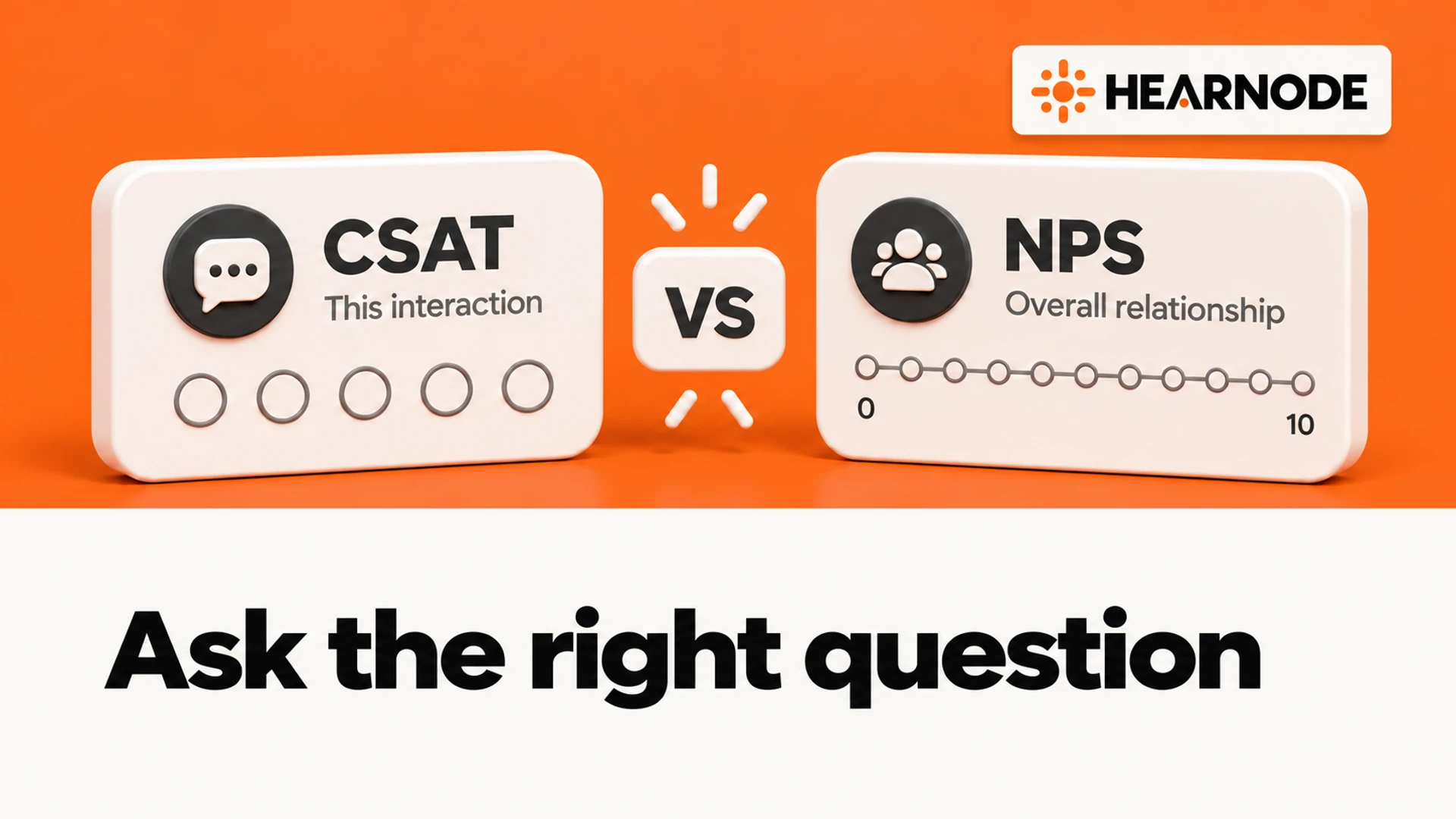
The confusion behind CSAT vs NPS is common because both surveys produce a single number and both sound like they measure how happy customers are. They don't measure the same thing, though. CSAT asks about a moment. NPS asks about a relationship. Once that distinction is clear, choosing between them, or using both, gets much easier.
CSAT vs NPS at a glance
| CSAT | NPS | |
|---|---|---|
| Measures | Satisfaction with a specific experience | Overall willingness to recommend |
| Typical question | “How satisfied were you with…?” | “How likely are you to recommend…?” |
| Scale | Usually 1 to 5 | 0 to 10 |
| When to ask | Right after the experience | On a regular cycle, once people know the product |
| Best for | Improving specific touchpoints | Tracking the relationship over time |
| Typical weakness | Can stay high while overall loyalty falls | Hard to act on without a follow-up question |
What CSAT measures
CSAT, short for customer satisfaction score, measures how satisfied someone was with a particular experience: a support conversation, an onboarding session, a newly shipped feature, a checkout. The question names the experience directly: “How satisfied were you with your support conversation today?”
It's usually answered on a five-point scale, from very dissatisfied to very satisfied. The most common way to report it is the share of respondents who chose one of the top two options. If 120 people answer and 84 choose 4 or 5, your CSAT is 84 ÷ 120 = 70%. Some teams report the average score instead. Either is fine, as long as you're consistent and always show how many people answered.
CSAT's strength is precision. Because it's tied to a moment, a low score points at something specific you can investigate and improve. A dip in onboarding satisfaction after you changed the setup flow is a clear, testable signal, and you can check whether your fix worked by watching the same question over the next few weeks.
What NPS measures
NPS, or Net Promoter Score, asks how likely someone is to recommend your product, on a scale from 0 to 10. It's the percentage of promoters (9 and 10) minus the percentage of detractors (0 to 6). Because recommending something puts your own reputation on the line, NPS is often treated as a measure of loyalty, a broader and slower-moving thing than satisfaction with any single moment.
On its own, the score is hard to act on. The follow-up question, asking why, is where the useful information is. We go into the wording in detail in NPS survey questions.
When to use CSAT
CSAT fits best right after a specific, bounded experience, while it is still fresh:
- After a support conversation is resolved. Was the customer satisfied with how it was handled?
- At the end of onboarding. Did setting up the product go well?
- After using a new feature a few times. Is it working for them?
- After a purchase, renewal or plan change. Was the process smooth?
- After a help article, with a lighter version: “Did this answer your question?”
When to use NPS
NPS fits best when you want a periodic read on the overall relationship:
- On a regular cycle, such as every few months per customer, once they've used the product for a while.
- Before renewal periods, to spot accounts whose enthusiasm has faded.
- Across segments, to compare how different groups of customers feel about the product overall.
- As a long-term trend, to see whether the relationship is improving as the product changes.
What NPS is poorly suited to is the moment right after a single interaction. Asking someone whether they'd recommend your whole product right after a support chat mostly measures the chat, and dresses it up as something bigger.
Where CSAT and NPS each mislead you
CSAT can stay high while customers drift away
Every support conversation can be rated very satisfied while the customer is quietly unhappy with the product itself. CSAT measures what you ask about. If you only ask about touchpoints, you'll only learn about touchpoints. That's how teams end up with excellent satisfaction scores and disappointing renewals.
NPS can move for reasons that are hard to trace
A price change, a competitor's launch or a shift in a customer's own business can all move NPS without anything changing in your product. Without the follow-up explanations, you can spend weeks debating a five-point drop with no idea what caused it.
Both mislead with small samples
Twenty responses can swing either score dramatically. Always report the number of responses alongside the score, label small samples as small and avoid reacting to movements that could be noise. A segment where nobody responded has no data, not a score of zero.
What about CES?
You may also come across CES, the customer effort score, which asks how easy it was to get something done, such as “How easy was it to resolve your issue today?” It's closely related to CSAT and especially useful for support and self-service flows, where reducing effort tends to matter more than delighting people. If you're choosing a single moment-based survey, CSAT is the more general starting point. CES is worth adding when ease is the thing you're trying to improve.
Using CSAT and NPS together without asking people twice
Most products benefit from both: CSAT for moments, NPS for the relationship. The risk is surveying the same person too often. A few rules keep it under control:
- Decide which moments get CSAT, and keep the list short.
- Run NPS on a separate, slower cycle for each customer, not for everyone on the same day.
- Don't send both to the same person in the same week. If someone just answered a CSAT survey, skip them for NPS this round.
- Keep each survey to one question plus an optional explanation.
- Respect dismissals. Someone who closed a survey is telling you something about timing.
Survey frequency deserves its own attention, because over-asking damages the quality of every answer you get. We cover that in how often you can survey customers.
CSAT vs NPS in business software
If you sell to companies, there's an extra wrinkle. The person answering your survey is often not the person who decides whether to renew. A daily user might rate a feature highly while the budget holder is weighing whether the product is worth its price. An administrator might be frustrated by setup while their team is perfectly happy.
This doesn't make either survey less useful, but it changes how you read them. Look at who answered, not just the score: their role, their account and how much they use the product. A healthy NPS from end users alongside silence from account owners is a different situation from an enthusiastic response across the board. Where you can, make sure each important account has a few different voices in the results.
Common mistakes with CSAT and NPS
- Using NPS as a support metric. It reacts to too many things outside the conversation to judge an agent fairly.
- Running CSAT once a year. Satisfaction with a moment can't be measured months later.
- Reporting a score without its response count. It hides how much the number can be trusted.
- Never reading the comments. The explanations are usually worth more than the score.
- Rewarding teams for the number itself. It encourages asking only happy customers, or asking at flattering moments.
Numbers, stars or faces for CSAT?
CSAT can be shown as numbers, stars or labelled faces. Numbers are precise and familiar in business software. Stars feel natural to consumers but carry associations with public reviews. Faces are quick and friendly, and work well on mobile, but make sure each one has a clear text label, so the meaning doesn't depend on reading an expression. Pick one format and keep it. Switching formats changes how people answer and breaks your trend.
Beyond satisfaction: did it actually work?
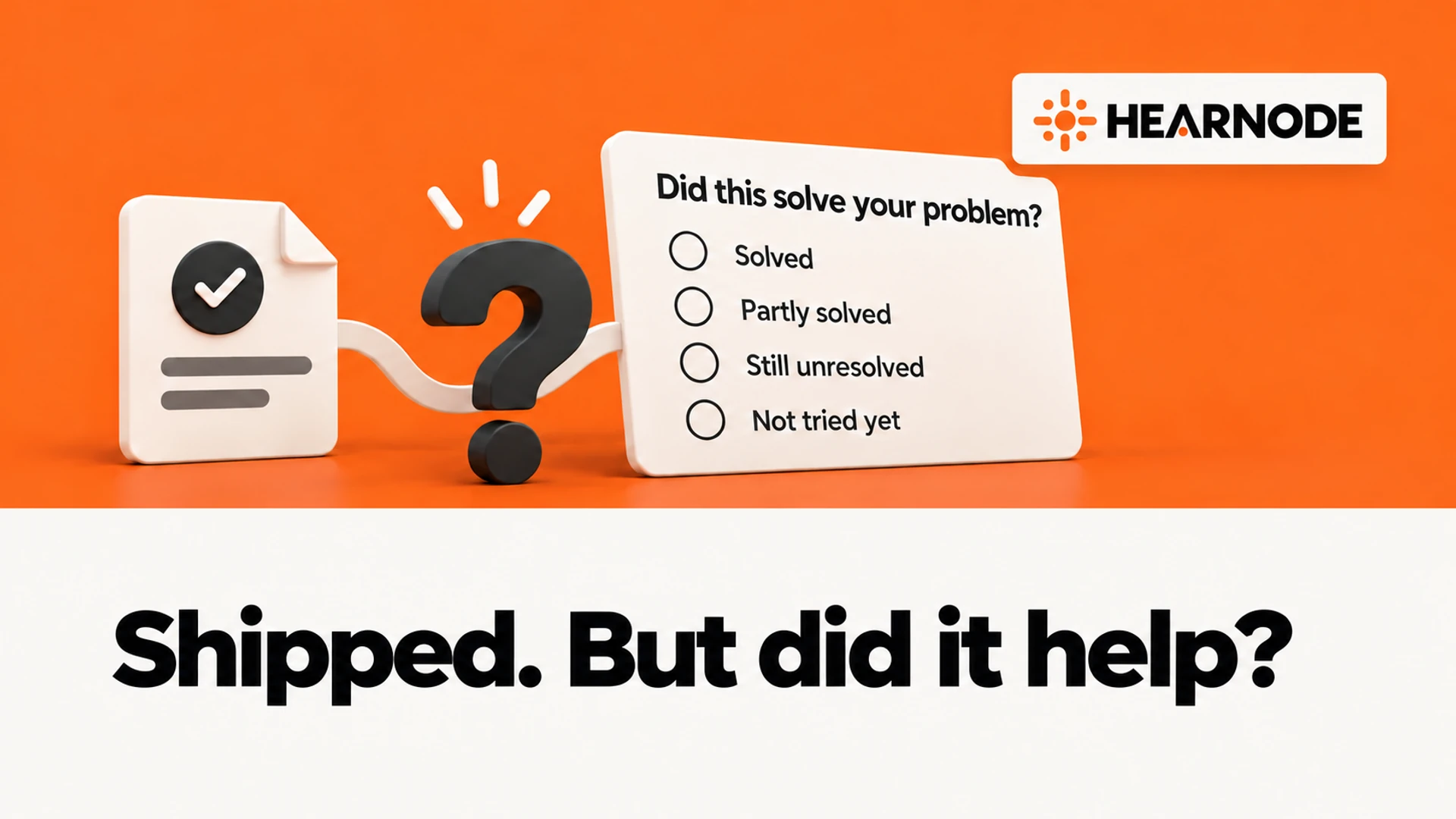
Neither CSAT nor NPS answers one of the most useful questions you can ask after shipping something: did this solve your problem? A customer can be satisfied with a new feature's design and still find that it doesn't solve the problem they asked about. For that, you need to ask the people who requested the change directly. Our article on post-launch feedback explains how.
Running CSAT and NPS surveys in Hearnode
Hearnode's Surveys include five survey types: recommendation (0 to 10), satisfaction (1 to 5, shown as numbers, stars or labelled faces), open text, quick poll and feature poll.
- Each survey can include an optional explanation after the score, and you can make it required.
- You choose placement, timing and the segment that sees it. Automatically shown surveys respect a seven-day cooldown after a dismissal.
- Customers answer once per campaign and aren't asked again after completing it.
- Results show how many valid responses they are based on. No responses is shown as no data, never as 0%, and small samples are labelled.
For the “did it work?” question, Customer Outcomes asks the people behind a shipped request whether it solved their problem. Outcome answers don't use your survey response allowance. The surveys guide covers both.
A simple way to decide
- Want to improve a specific experience? Use CSAT, right after it.
- Want to track how customers feel about the product overall? Use NPS, on a regular cycle.
- Want to know whether a change solved a problem? Ask the people who asked for it.
- Want all three? Fine, as long as no customer is asked more than one question at a time.
CSAT vs NPS: common questions
What is the difference between CSAT and NPS?
CSAT measures satisfaction with a specific experience, such as a support conversation, usually on a 1 to 5 scale. NPS measures how likely someone is to recommend your product overall, on a 0 to 10 scale. CSAT is about moments; NPS is about the relationship.
Which is better, CSAT or NPS?
Neither is better in general. CSAT is better for improving specific touchpoints because it points at a particular experience. NPS is better for tracking overall loyalty over time. Many products use both, at different moments.
How is CSAT calculated?
The most common method is the percentage of respondents who chose one of the top two options on a five-point scale. For example, 84 satisfied responses out of 120 gives a CSAT of 70%. Some teams use the average score instead.
Can you use CSAT and NPS together?
Yes. Use CSAT right after specific experiences and NPS on a slower, regular cycle. Avoid sending both to the same person in the same week, and keep each survey to one question plus an optional explanation.
What is a good CSAT score?
It depends on your product, customers and how you calculate it, so published benchmarks are of limited use. Your own trend over time, with enough responses to be meaningful, is a better guide than comparing with other companies.
Put this into practice with Hearnode
The features and guides behind this article.