Customer Research
NPS Survey Questions: The Follow-Up Matters More Than the Score
A score of 7 tells you almost nothing about what to change. The useful part of an NPS survey is the answer to the question that comes after the number. Here's how to word both, when to ask, and how to read the results honestly.
Hearnode Team9 min read
In This Article
- The standard NPS survey question
- Wording variations for different products
- Why the follow-up question matters more than the score
- NPS follow-up questions that get useful answers
- Relationship NPS vs transactional NPS
- Where to ask: inside the product or by email
- When to send an NPS survey
- Reading NPS results honestly
- What to do with the answers
- Recommendation surveys in Hearnode
- NPS survey questions: FAQs
Imagine two customers who both answer 7 on your recommendation survey. One explains that the product is solid but setting up their team took weeks. The other says it's fine, but they're only using one feature and wonder if they're on the right plan. Same score, two completely different stories, and two completely different things your team could do.
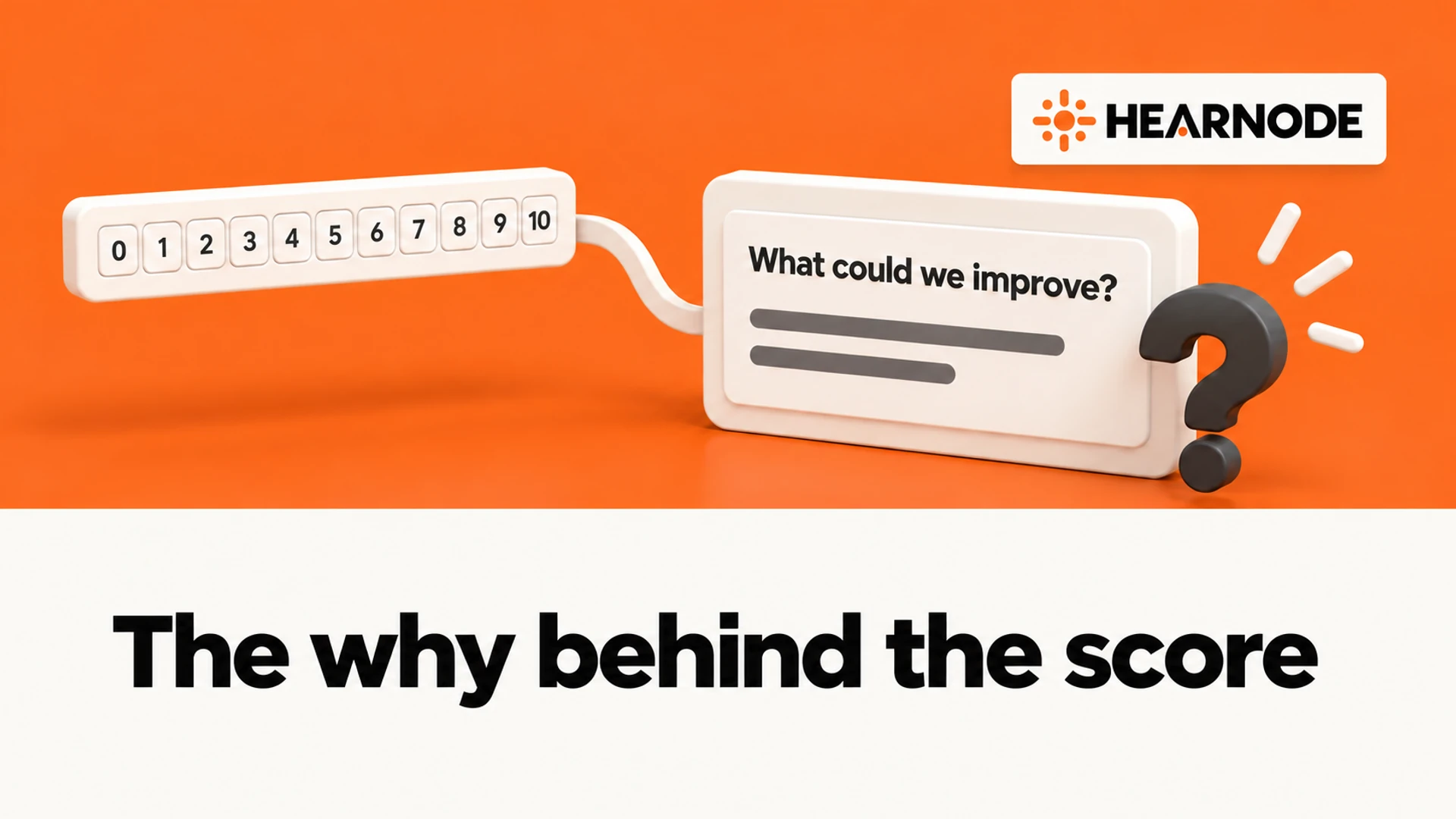
That's why the most important of all NPS survey questions isn't the famous one. The 0 to 10 question gives you a number to track. The follow-up question gives you the reason, and the reason is what you can act on. This guide covers the standard wording, the follow-ups that work, when to ask, and how to read the results without fooling yourself.
The standard NPS survey question
The classic wording is: “How likely are you to recommend [product] to a friend or colleague?” Customers answer on a scale from 0 (not at all likely) to 10 (extremely likely). Responses are grouped into three bands:
| Score | Group | What it usually means |
|---|---|---|
| 9–10 | Promoters | Enthusiastic; likely to recommend you |
| 7–8 | Passives | Satisfied but not excited; could be tempted away |
| 0–6 | Detractors | Unhappy or indifferent; may discourage others |
The score itself is the percentage of promoters minus the percentage of detractors, so it ranges from −100 to +100. For example, if 200 people answer and 90 are promoters (45%) and 50 are detractors (25%), the score is 45 − 25 = 20. Passives count toward the total but not toward either side.
Wording variations for different products
The standard question works for many products, but small changes can make it fit yours better. Keep the 0 to 10 scale and the idea of recommendation, so results stay comparable over time, and adjust the rest:
- Business software: “How likely are you to recommend [product] to a colleague at another company?” People rarely recommend work software to friends.
- One part of a larger product: “How likely are you to recommend [feature] to someone who does similar work?”
- After a specific experience: “Based on your onboarding, how likely are you to recommend [product]…?” This turns NPS into a moment-specific question, which is fine as long as you don't mix the results with your general score.
Whatever wording you choose, write it down and stick to it. Changing the question halfway through a year makes the trend meaningless.
Why the follow-up question matters more than the score
A score tells you how much customers like you. It doesn't tell you why, and it certainly doesn't tell you what to fix. Teams that only collect the number tend to fall into a familiar pattern: the score moves a few points, there's a meeting about whether that's meaningful, and nothing changes in the product because nobody knows what drove it.
The follow-up question changes that. A few hundred short explanations, read and grouped, will tell you more about your product than years of scores. That's where the effort in an NPS survey should go.
Here's what that looks like in practice. Suppose a quarter's survey produces a score that barely moved. On its own, that's a shrug. But when the explanations are grouped, a pattern appears: a third of detractors mention the same slow report, and several passives say they'd score higher if they could share dashboards with clients. Now you have two concrete pieces of work, each backed by customers' own words, and a way to check next quarter whether fixing them made a difference.
NPS follow-up questions that get useful answers
One open question for everyone
The simplest follow-up works well: “What's the main reason for your score?” It's neutral, it applies to every score, and it doesn't lead the customer. Make it optional by default. Forcing an explanation produces filler like “ok” or “no reason”, and it puts some people off answering at all.
Tailored follow-ups by score
If you can show a different follow-up depending on the score, you can ask a slightly more targeted question:
| Score band | Follow-up question | What you learn |
|---|---|---|
| 9–10 | “What do you value most about [product]?” | What to protect and what to say in marketing |
| 7–8 | “What would make [product] more useful to you?” | The gap between fine and great |
| 0–6 | “What is the biggest problem you have with [product]?” | What is driving dissatisfaction |
NPS follow-up questions to avoid
- Leading questions, such as “What do you love about us?” sent to everyone.
- Two questions in one, such as “What do you like and dislike?” People answer one half.
- Long lists of extra questions. Every additional question lowers completion. If you need more, run a separate survey.
- Questions you won't act on. If nobody will read the answers to a question, don't ask it.
Relationship NPS vs transactional NPS
You'll see NPS used in two different ways, and it's worth being deliberate about which one you're running.
- Relationship NPS asks about the product overall, on a regular cycle. It tracks how customers feel over time and is what most people mean by NPS.
- Transactional NPS asks right after a specific event, such as onboarding or a support conversation. It tells you how that moment shaped someone's view.
Both are legitimate. The mistake is mixing them in one number. A score collected right after support chats will behave very differently from one collected quarterly from all customers, and averaging the two produces a figure that describes neither. If you run both, report them separately. And for many event-based questions, a satisfaction survey is a better fit than NPS anyway, since it asks about the experience directly instead of about recommending the whole product.
Where to ask: inside the product or by email
An NPS survey shown inside your product reaches active users while they're using it, which tends to produce more responses and more specific explanations. An emailed survey reaches people who rarely log in, including some of the customers you most need to hear from, but response rates are usually lower and answers shorter.
If you can only choose one, in-product is usually the better default for software. Just remember who you're missing: customers who have quietly stopped using the product won't see an in-app survey at all. Their silence is a signal in its own right.
When to send an NPS survey
NPS is a relationship question. It asks how someone feels about your product overall, so it works best when they've had time to form a view. A few guidelines:
- Wait until people have real experience. Asking someone on day two measures their first impression, not the relationship.
- Ask on a regular cycle, such as every few months for each customer, rather than in one big blast to everyone at once.
- Avoid stressful moments. Asking during an outage, a billing problem or a support escalation measures the incident, not the relationship.
- Respect people who decline. If someone dismisses the survey, wait before showing it again.
- Don't stack surveys. If someone just answered a satisfaction survey, don't follow it with NPS the same week.
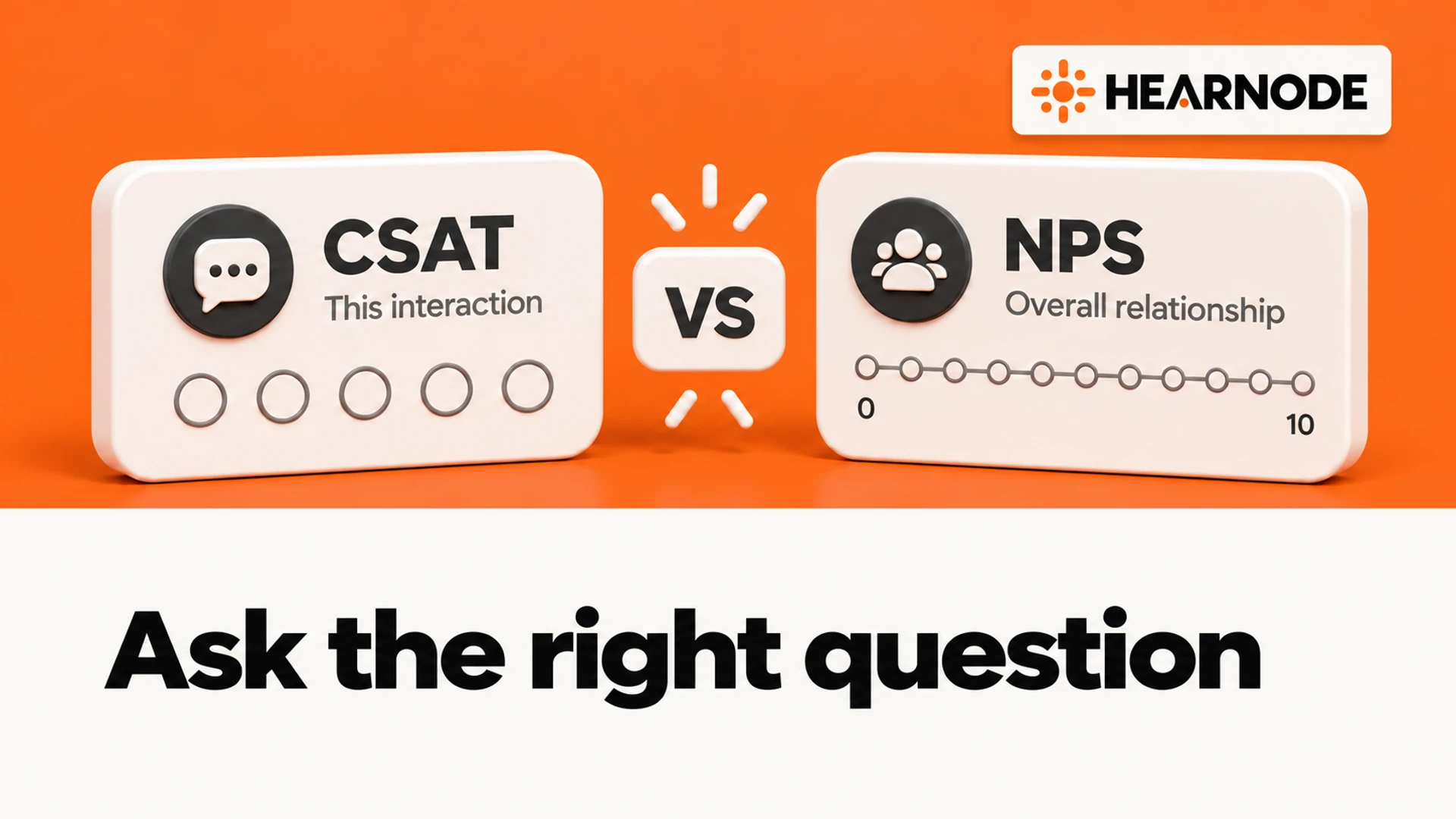
If you're also running other surveys, coordinate them. Our guide to survey fatigue explains how quickly frequent asking erodes the quality of answers. And if you're unsure whether NPS is even the right survey for a particular moment, CSAT vs NPS compares the two.
Reading NPS results honestly
NPS is easy to calculate and easy to misread. A few habits keep the number honest:
- Always show how many people answered. A score of 40 from 12 responses and a score of 40 from 1,200 responses are very different claims.
- Label small samples as small. A swing of ten points between two months with thirty responses each may be nothing but noise.
- Treat no responses as no data, not as zero. A segment where nobody answered has an unknown score, not a bad one.
- Look at segments. A healthy overall number can hide an unhappy group, such as new customers or a particular plan.
- Compare with yourself, not with other industries. Published benchmarks vary widely in method and audience. Your own trend is more useful.
What to do with the answers
The survey only pays off if the explanations lead somewhere. A simple routine:
- Read every comment, at least for the first few rounds. Patterns jump out quickly.
- Group them into themes, such as onboarding, pricing, reporting or support.
- Reply to detractors who left a reason, especially where you can help or explain. Many never expected anyone to read their comment.
- Turn recurring themes into requests on your feedback board, linked to the comments behind them.
- Tell people when something changes because of what they said. See how to close the feedback loop.
Detractor comments deserve particular attention, because a low score with no follow-up from you is often a quiet step toward cancelling. We look at those signals in why customers churn without complaining first.
Recommendation surveys in Hearnode
Hearnode's Surveys include a recommendation survey on the 0 to 10 scale described above, alongside satisfaction, open text, quick poll and feature poll surveys.
- Customers can add an explanation after scoring. It is optional by default, and you can make it required.
- You choose where and when the survey appears, and for which segment. Automatically shown surveys respect a seven-day cooldown after someone dismisses them.
- Each customer answers once per campaign and is not asked again after completing it.
- Results always show how many valid responses they are based on and which were excluded. No responses are shown as no data, never as 0%, and small samples are labelled.
- Answers are never preselected or generated for customers.
The surveys guide covers setting up a recommendation survey and reading its results.
Net Promoter®, NPS® and Net Promoter Score℠ are marks of Bain & Company, Inc., NICE Systems, Inc. and Fred Reichheld.
NPS survey questions: FAQs
What is the NPS survey question?
The standard question is “How likely are you to recommend [product] to a friend or colleague?”, answered on a scale from 0 (not at all likely) to 10 (extremely likely). Many business products replace “friend” with “colleague at another company”.
What is a good NPS follow-up question?
“What is the main reason for your score?” works for every response because it is neutral and open. If you can tailor follow-ups, ask promoters what they value most, passives what would make the product more useful and detractors about their biggest problem.
How many questions should an NPS survey have?
Two is usually right: the 0 to 10 question and one optional open follow-up. Every extra question reduces completion. If you need to learn more, run a separate, focused survey.
How is NPS calculated?
Subtract the percentage of detractors (scores 0 to 6) from the percentage of promoters (scores 9 and 10). Passives (7 and 8) count toward the total but not toward either group. The result ranges from −100 to +100.
How often should you send an NPS survey?
Ask each customer on a regular cycle, such as every few months, once they have enough experience to judge the product. Avoid surveying during incidents or right after another survey, and respect people who dismiss it.
Put this into practice with Hearnode
The features and guides behind this article.