Customer Research
Post-Launch Feedback Is the Step Most Teams Skip
Most teams treat shipping as the finish line. Whether the change actually solved the problem for the people who asked for it is rarely checked. Post-launch feedback is the short, often skipped step that tells you whether you're done, or only finished.
Hearnode Team8 min read
In This Article
- Why post-launch feedback gets skipped
- Shipped is not the same as solved
- The one question post-launch feedback should ask
- Answer options that don’t flatter you
- Why no response is not success
- Who to ask, and when
- Turning “partly solved” into the next piece of work
- Three post-launch feedback examples
- Post-launch feedback vs usage data
- Running a short post-launch review as a team
- Post-launch feedback with Hearnode Customer Outcomes
- Post-launch feedback FAQs
The feature shipped on time. The release notes went out. The request on the feedback board was marked Complete, and the team moved on to the next thing on the roadmap. Six weeks later, one of the customers who asked for it mentions on a call, almost in passing, that they never really started using it. It didn't fit how their team works. They went back to their spreadsheet.
Nobody on the team knew, because nobody asked. That's the gap post-launch feedback fills. It's a simple question, put to the people who asked for a change, after they've had time to try it: did this solve your problem? The answers are some of the most useful feedback you'll ever collect, and most teams never collect them.
Why post-launch feedback gets skipped
It isn't that teams don't care. The step just falls into a gap:
- Shipping feels like the end. The work is done, the ticket is closed, and the next project is already waiting.
- Nobody owns it. Product moved on, engineering moved on, and support only hears about problems if customers complain.
- Usage numbers seem to answer it. If people use the feature, it must work. (Not necessarily, as we'll see.)
- It feels risky. Asking whether something worked invites the answer no, and that's uncomfortable.
- There's no simple way to reach the right people. By launch day, the link between the feature and the customers who asked for it has often been lost.
Shipped is not the same as solved
A feature can be built exactly to spec and still miss. Some common ways that happens:
- It solves the stated request, not the underlying problem. The customer asked for an export; what they needed was a monthly report for their manager.
- It solves half the problem. It works for small accounts but not for the customer's volume, or it covers one workflow but not the second one they mentioned.
- It doesn't fit their workflow. The feature lives somewhere they never go, or needs a setup step they don't have time for.
- They already moved on. By the time it shipped, they'd built a workaround and switching back isn't worth the disruption.
None of these show up in a release checklist. Only the customer can tell you, and only if you ask. The cost of not asking is subtle: the request stays marked Complete, the team believes the problem is gone, and the customer quietly concludes that telling you about problems doesn't really lead anywhere.
The one question post-launch feedback should ask
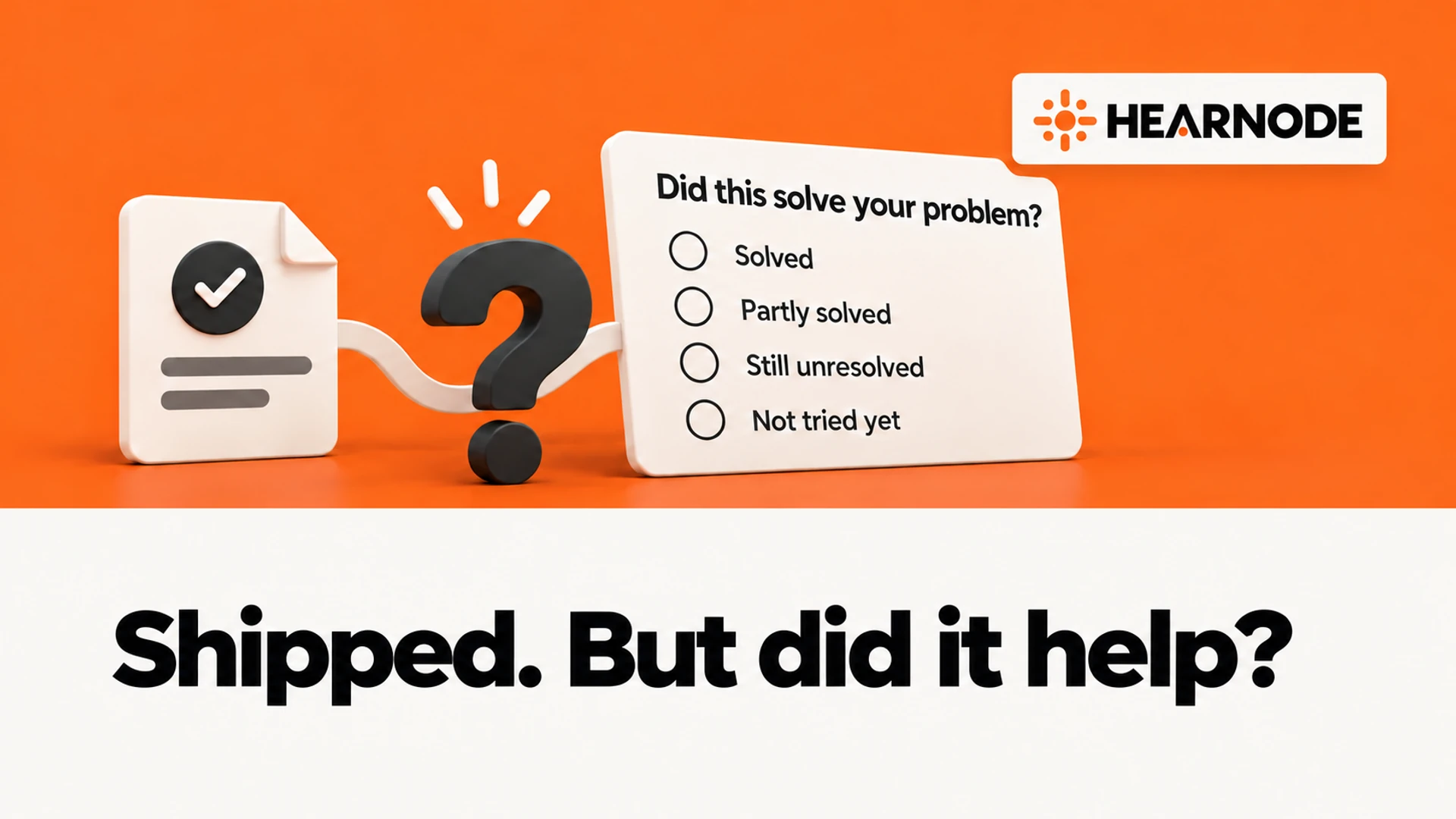
Keep it simple, even if it feels almost too simple: “Did this solve your problem?” Not “How do you like the new feature?”, which invites politeness, and not a ten-question survey, which invites silence. The question is about the problem they originally described, which is why it should go to the people who described it.
Add an optional space for a short explanation, and keep that explanation private to your team. Customers are much more candid when they know their answer won't be published or shown to other customers.
Answer options that don’t flatter you
A yes/no question hides the most useful answers. Four options work much better:
| Answer | What it means | What to do next |
|---|---|---|
| Solved | The change did what they needed | Close the loop; consider inviting a testimonial |
| Partly solved | Progress, but something is still missing | Read the explanation; create linked follow-up work |
| Still unresolved | The change did not fix their problem | Talk to them; find out what was missed |
| Not tried yet | They have not used it | Wait and ask again later, or check discoverability |
Not tried yet deserves special mention. It's a valid answer, not a failure, and offering it stops people from guessing. A lot of Not tried yet answers can also be a signal in its own right: maybe the people who asked didn't hear it shipped, or can't find it.
Why no response is not success
It's tempting to read silence as satisfaction. If nobody complains, it worked, right? Not really. People who didn't respond might be happy, might be too busy, might not have tried it, or might have given up. You don't know, and treating silence as solved will make your results look better than they are.
Report non-responses separately. Twelve solved, three partly solved, two unresolved, eight no answer is an honest picture. Eighty percent success calculated by ignoring the eight is not.
Who to ask, and when
Ask the people connected to the original request: the customers who submitted it, voted for it or followed it. They're the ones who know what problem it was meant to solve. Sending the question to every user dilutes the answers with people who had no stake in it.
Timing matters too. Ask too soon and most answers will be Not tried yet. Ask too late and people will have forgotten what they originally wanted. A couple of weeks after release, once people have had a real chance to use it, is a sensible default for most changes. For features used monthly, wait a little longer.
Turning “partly solved” into the next piece of work
The Partly solved and Still unresolved answers are where the value is. Handle them deliberately:
- Read every explanation. They usually point to a specific gap.
- Group similar gaps. Three customers missing the same thing is a clear next step.
- Create follow-up work linked to the original request and release, so the history stays connected.
- Reply to the people who answered, especially those who explained. A short “thanks, we're looking at this” keeps them engaged.
- Ask again after the follow-up ships. The loop isn't closed until the answer is Solved, or you've decided it won't be.
Three post-launch feedback examples
To make this less abstract, here's how the answers can play out for three different releases.
A reporting feature that mostly worked
Twenty customers asked for scheduled reports. After release, fourteen answer Solved, four answer Partly solved and two haven't tried it. All four partial answers mention the same thing: they need reports sent to people outside their account. That's one clear follow-up, already backed by four customers' own words, and fourteen satisfied customers who might be glad to say so publicly.
A fix that missed the real problem
Customers reported that imports were failing. The team fixed a timeout and shipped. Post-launch feedback comes back mostly Still unresolved. The explanations reveal that the failures were caused by file formats, not timeouts. Without asking, the team would have marked the issue fixed and moved on, while the same customers kept failing and, eventually, kept quiet. We look at what that silence leads to in why customers churn without complaining first.
A feature nobody had tried yet
A permissions feature ships, and most answers are Not tried yet. The team checks and finds the setting buried three levels deep in admin settings, and the release announcement only went to the general changelog. A short in-app note to the admins who asked, and a follow-up a few weeks later, turns most of those answers into Solved.
Post-launch feedback vs usage data
Usage data and post-launch feedback answer different questions. Usage tells you whether people use something. Feedback tells you whether it solved their problem. A feature can be used heavily because it's the only way to do something, while still being frustrating. And a feature can be used rarely because it solves a monthly problem perfectly.
You want both. IntensePath has a thorough piece on measuring whether a design change worked, including taking a baseline before the change and reporting honestly when the result is unclear. Post-launch feedback adds the customer's own verdict to that picture.
Running a short post-launch review as a team
Once the answers are in, a short post-launch review helps the team learn from them. Thirty minutes is enough. A few questions to cover:
- What did the people who asked for this say? How many answered, and how?
- Where did Partly solved and Still unresolved answers cluster?
- Did we understand the original problem correctly? If not, where did we lose it?
- What follow-up work, if any, are we committing to?
- What would we do differently when scoping the next similar request?
Over time, these reviews make your team noticeably better at scoping requests, and they're one of the best defences against feature creep, because they show which kinds of additions actually help.
Post-launch feedback with Hearnode Customer Outcomes
Hearnode's Customer Outcomes module exists for exactly this step.
- Connect: link a release in Changelog & Announcements to the requests it delivers. The people who followed or voted on those requests become the follow-up audience.
- Ask: send one question, did this solve your problem?
- Answer: customers choose Solved, Partly solved, Still unresolved or Not tried yet, and can add a private explanation that only your team sees.
- Review: answers arrive in an internal queue for your team to read and act on. No answer is never counted as solved.
- Follow up: create linked corrective work from a partial or unresolved answer, so it stays connected to the original request and release.
There's no fixed schedule; your team decides when to ask. Outcome answers don't use your survey response allowance. And after a Solved answer, you can choose to invite that customer to give a testimonial. The invitation is optional and neutral, and permission to publish is asked separately, as we describe in how to ask for a testimonial. The outcomes guide explains the setup.
Post-launch feedback turns we shipped it into we solved it, or tells you honestly that you haven't yet. It's a small habit, a single question asked at the right moment, and it changes how a team understands its own work.
Post-launch feedback FAQs
What is post-launch feedback?
Post-launch feedback is feedback collected after a feature or change ships, asking the customers who requested it whether it solved their problem. It shows whether a release achieved its purpose, not just whether it was delivered.
When should you ask for feedback after a launch?
Usually a couple of weeks after release, once the people who asked have had a real chance to use the change. Ask too early and most will not have tried it; ask too late and they may have forgotten the original problem.
What questions should you ask after launching a feature?
One main question works best: did this solve your problem? Offer four answers, solved, partly solved, still unresolved and not tried yet, plus an optional private explanation.
What is a post-launch review?
A post-launch review is a short team discussion after a release, looking at what customers said, where the change fell short, whether the original problem was understood correctly and what follow-up work is needed.
What if customers do not respond to post-launch follow-ups?
Report non-responses separately rather than counting them as success. A high rate of no answers or “not tried yet” may mean the people who asked did not hear the change shipped or cannot find it.
Put this into practice with Hearnode
The features and guides behind this article.