Product Decisions
How to Prioritize Feature Requests When Every Customer Says Theirs Is Urgent
Urgency is how a request feels to the person asking. Priority is what it's worth to your product. Teams that mix the two end up building for whoever pushed hardest last week. This is how to prioritize feature requests without that happening.
Hearnode Team9 min read
In This Article
- Urgency is not priority
- How to prioritize feature requests in five steps
- A simple weighted scoring example
- Handling requests that genuinely cannot wait
- Who should be involved when you prioritize feature requests
- How often to revisit your priorities
- Common mistakes when prioritizing feature requests
- Prioritizing feature requests in Hearnode
- Explaining your priorities to customers
- Questions about prioritizing feature requests
It's Tuesday, and three requests land at once. A prospect in the middle of a large deal needs a specific integration “before we can sign”. A long-time customer writes, clearly frustrated, about a reporting limitation that has bothered them for months. And your co-founder has an idea from a conference that they're excited about. All three are presented as urgent. You have room for one.
If you've worked on a product for a while, you know how this usually goes. The loudest voice wins, or the most recent one, or the one attached to the most money. Three months later you notice the roadmap is a record of who pushed hardest, not of what mattered most. Learning how to prioritize feature requests is mostly about building a habit that resists that pull.
Urgency is not priority
The first step is separating two things that feel the same in the moment. Urgency describes the requester: how strongly they feel, how soon they want it, how loudly they ask. Priority describes the request: how much value it creates, for how many of the right customers, at what cost.
A request can be extremely urgent to one customer and low priority for the product. The reverse happens too: a quiet request from several accounts may be worth more than any of the noisy ones. The same distinction shows up outside product work. Zealsync makes the point well in its piece on what to fix first after a website audit: a severity label tells you how far something is from ideal, not what to do first.
Keeping the two apart doesn't mean ignoring urgency. It means recording it as context and deciding with something steadier.
How to prioritize feature requests in five steps
This approach works for teams of any size, and it doesn't depend on a particular framework. It does depend on making some decisions once, in advance, so you don't argue them again for every request.
1. Agree on what you are optimizing for
Priorities only make sense against a goal. This quarter it might be reducing churn among small accounts, or winning a specific segment, or making onboarding faster. Write it down. When two requests compete, the one that serves the goal should usually win, even if the other is louder.
2. Choose a few benefit factors and a few cost factors
Benefit factors describe what a request is worth. Typical ones are customer impact, number of affected accounts and strategic fit. Cost factors describe what it takes: effort, risk and sometimes ongoing maintenance. Two or three of each is plenty. More factors don't make the result more accurate. They just make scoring slower.
3. Weight the factors once, not for every request
If strategic fit matters twice as much as raw demand this quarter, say so in the weights. That way the team's agreement about what matters is built into the score instead of renegotiated in every meeting. Revisit the weights when your goal changes, not when a particular request needs a boost.
4. Score with the information you actually have
Each request gets a value for each factor, on a small, consistent range. When an input is missing, leave the request unscored rather than filling in a zero. A request with no effort estimate isn't cheap. It's just unknown, and treating unknown as cheap is how expensive work sneaks onto roadmaps.
5. Make the decision separately from the score
A score is a summary. It doesn't know about the dependency between two requests, the engineer who's leaving next month or the partner you promised something to. Use the score to frame the conversation, then make a deliberate decision about what moves to the roadmap. Writing down why you chose differently from the score, when you do, is a good habit.
A simple weighted scoring example
Here are the three Tuesday requests, scored with two benefit factors and two cost factors on a 1 to 5 range. In this example, the goal is reducing churn, so customer impact is weighted twice. The score is total weighted benefit minus total cost.
| Request | Customer impact (×2) | Accounts affected | Effort | Risk | Score |
|---|---|---|---|---|---|
| Integration for one prospect | 2 (4) | 1 | 4 | 3 | −2 |
| Reporting improvement | 4 (8) | 4 | 2 | 1 | 9 |
| Conference idea | 3 (6) | 2 | Not estimated | 2 | Unscored |
The reporting improvement comes out well ahead, which matches what the frustrated customer was telling you. The prospect's integration scores poorly on its own, but that doesn't settle it. If the deal is large enough, you might still choose to build it, as a deliberate exception, with the reasoning written down. The conference idea can't be compared until someone estimates the effort. That's not a failure; it's the system telling you what's missing.
Handling requests that genuinely cannot wait
Some things really are urgent: a security issue, data loss, a legal requirement, an outage. These shouldn't go through the scoring process at all. Agree on a short list of categories that skip the queue, and keep it short. If everything can be called an emergency, nothing will be.
Big deals are the trickiest case. A clear rule helps: sales can bring a request forward with the deal value and the customer's own words, but product makes the call. If you build something for one deal, record it as an exception, so the roadmap stays honest about why it contains what it contains.
Whatever you decide, tell the salesperson and the prospect the same thing, and soon. A clear “not this quarter” lets sales plan around it. A vague maybe that turns into a no after the contract is signed does lasting damage to trust on both sides.
Who should be involved when you prioritize feature requests
Prioritizing alone is fast and usually wrong in ways you can't see. Prioritizing with everyone is slow and turns into negotiation. A small group with clear roles works best:
- Product owns the decision and the scoring model, and makes the final call.
- Engineering provides effort and risk estimates, and flags dependencies the score can’t see.
- Support brings how often a problem comes up and how much it hurts, including from customers who never vote.
- Sales or success brings deal and renewal context, with the customer’s own words rather than a summary.
- Design points out where a request overlaps with something already planned or would complicate the product.
Everyone contributes inputs. One person decides. When the decision differs from what the score suggests, that person writes a sentence about why. It sounds bureaucratic, but those sentences become very useful six months later, when someone asks why the roadmap looks the way it does.
How often to revisit your priorities
New requests should be reviewed weekly, so they get scored while the context is fresh. The weights and the overall order deserve a deeper look less often, usually when your goals change at the start of a quarter. Re-ranking everything every week creates churn: work gets started and dropped, and the team loses faith in the list.
A useful middle ground is to re-score only the requests whose inputs have changed: a new estimate, a big jump in affected accounts, or a shift in strategy that changes how well they fit. Everything else keeps its score until the next quarterly review.
Common mistakes when prioritizing feature requests
- Treating vote counts as a ranking. Popularity is one input. It says nothing about cost.
- Scoring everything to two decimal places. False precision makes arguments longer, not shorter.
- Changing weights to get the answer you wanted. If the weights move every week, the score is decoration.
- Letting the score make the decision. It's a guide. People still decide.
- Never revisiting old scores. Customer needs change. A request scored a year ago may be worth more, or less, now.
There's also the slower mistake of saying yes to too many reasonable things. Each one makes sense; together they make the product harder to use. We wrote about that pattern in feature creep rarely starts with a bad idea.
Prioritizing feature requests in Hearnode
Hearnode's Feature Prioritization works the way this article describes, because that's the approach we think holds up best.
- You define your own benefit factors and cost factors, set each one’s range and choose whether it is required.
- Weights are set once for the Brand, so the agreement about what matters is built into every score.
- The formula is benefit minus cost, applied the same way every time. There is no automatic revenue weighting.
- If a required input is missing, the request is marked Unscored instead of being treated as zero.
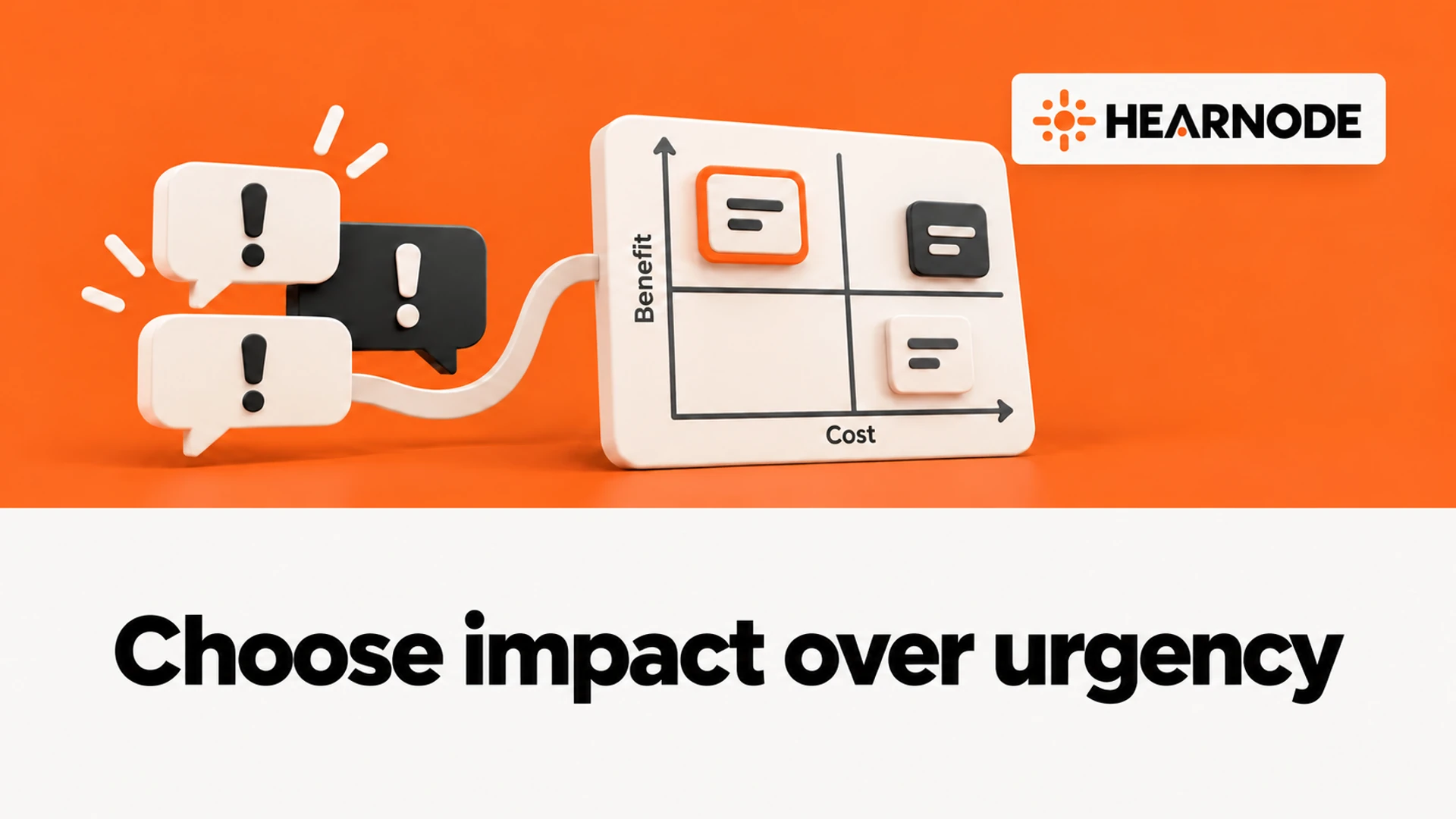
- Requests appear on a sortable list and on a matrix, with cost across and benefit up, so quick wins and expensive bets are easy to spot.
- Votes, followers, accounts and discussion sit beside the score, and a score never changes a request's public status on its own.
Moving a request onto the product roadmap is a separate, deliberate step. The prioritization guide explains how to set up factors for your first Brand.
Explaining your priorities to customers
The customer whose request scored low still deserves an answer. You don't need to publish your scoring model, but you can explain the reasoning in plain terms: what you're focused on this quarter and why their request isn't part of it yet. Many customers take a clear, honest answer better than you'd expect. It's silence that sours the relationship.
A public roadmap helps here too. When customers can see what you're working on and roughly why, fewer of them feel the need to make their request sound urgent in the first place. That's the real payoff of prioritizing well: less shouting, because people trust the process.
Questions about prioritizing feature requests
How do you prioritize feature requests?
Agree on a goal, pick a few benefit and cost factors, weight them once, and score each request with the information you have. Leave requests with missing inputs unscored, then make the final decision deliberately, using the score as a guide rather than an answer.
What is the best feature prioritization framework?
The best one is the one your team will apply consistently. Weighted benefit-minus-cost scoring works well because the factors and weights reflect your own goals. Frameworks such as RICE are useful too, but each has blind spots worth understanding.
Should the customer with the biggest contract get priority?
Contract size is relevant context, not an automatic override. If you build something mainly for one large customer, treat it as a deliberate, recorded exception, so your roadmap stays honest about why it contains what it does.
How often should you re-prioritize feature requests?
Review new requests weekly and revisit priorities when your goals change, typically each quarter. Changing weights or scores every week makes the process meaningless.
How do you handle urgent feature requests from customers?
Record the urgency as context and score the request like any other. Only a short list of categories, such as security issues, data loss, legal requirements and outages, should skip the process entirely.
Put this into practice with Hearnode
The features and guides behind this article.