Roadmaps & Releases
A Roadmap Without Dates Can Still Answer “When?”
Exact dates slip, and every slip costs trust. Removing dates altogether leaves customers guessing, which costs trust too. A roadmap without dates works when it replaces the date with something more honest, not with nothing.
Hearnode Team9 min read
In This Article
- Why exact dates on a roadmap cause trouble
- What a roadmap without dates still tells customers
- Ways to answer “when?” without a deadline
- When an exact date is fine
- Keep internal targets and public estimates apart
- How to revise a public estimate honestly
- Get sales and support saying the same thing
- Don’t hide work that has no date
- What to say when a customer asks “when?”
- A roadmap without dates in Hearnode
- Roadmap without dates: FAQs
Sooner or later, every customer who looks at your roadmap asks the same thing: when? If your roadmap shows exact dates, you've answered, and you've also made a promise that a sick engineer, a tricky bug or a shifted priority can break. If it shows no time information at all, the customer is left to guess, and people usually guess optimistically.
There's a middle path, and it's the one most experienced teams end up on. A roadmap without dates doesn't avoid the question. It answers it with the information you actually have: what you're working on now, what's next, and roughly how far away the rest is. Done well, it gives customers enough to plan around without turning your plans into deadlines.
Why exact dates on a roadmap cause trouble
Software estimates are uncertain, especially for work that hasn't started. Building something new works that way, however good the planning. The problem is that a date on a public roadmap doesn't look uncertain. It looks like a commitment.
- Customers plan around it. Someone tells their boss the feature arrives in March. When it doesn't, they look bad, and they blame you.
- Sales uses it. A date on the roadmap ends up in a proposal, and now it's part of a deal.
- Your team works toward it. Teams under date pressure cut scope or quality to hit a number that was a guess in the first place.
- Every slip is visible. One delay is forgivable. Several erode the credibility of everything else on the roadmap.
What a roadmap without dates still tells customers
Removing dates doesn't remove information. A good undated roadmap still communicates three useful things:
- Order. What comes before what. Customers can see whether their request is near the front or far back.
- Status. Whether something is being worked on right now, or still waiting.
- Momentum. What has recently shipped, which is the best evidence of how fast things move.
That last one is underused. A “recently completed” column does more to answer when? than any date, because it shows real pace instead of promised pace. Customers who can see that items tend to move from Next to shipped within a couple of months will form a reasonable expectation on their own, and it will usually be more accurate than any date you'd have guessed at.
Ways to answer “when?” without a deadline
There are several ways to give customers a sense of timing without committing to a specific day. You can mix them.
Now, Next, Later
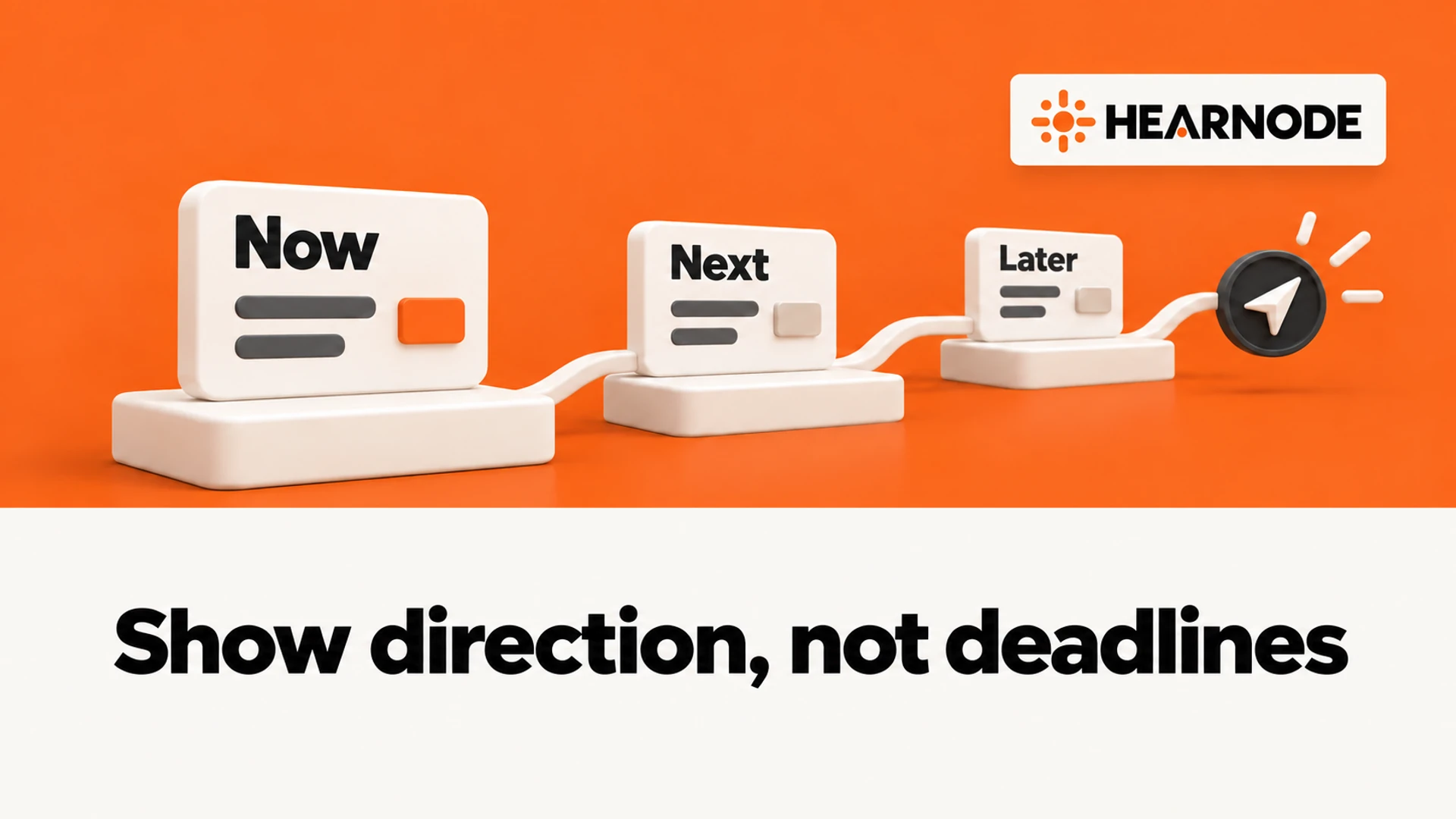
The most popular format for a roadmap without dates. Now is what's in progress. Next is what comes after, usually within a few months. Later is the direction you're heading, with no timing implied. It's simple, it reads well, and it's hard to break. The main risk is that Later turns into a parking lot. Review it regularly and remove anything that has no realistic path to Next.
Quarters and ranges
For items you're more confident about, a quarter (Q3) or a range (spring, in the next two to three months) adds useful timing without pinning you to a date. Use them for the near term only. A quarter a year away is almost as fragile as an exact date.
Confidence labels
Some teams add a simple confidence note: likely, possible, exploring. It sets expectations honestly, though it only works if you use the labels consistently and update them as things become clearer.
Recently shipped
A column or section showing what was completed in the last month or two is the most persuasive timing signal you can give. It doesn't promise anything about the future. It just shows, with evidence, how quickly things tend to move from Next to Done. Customers draw their own conclusions, and those conclusions are usually fair.
| Approach | What customers learn | Works best for |
|---|---|---|
| Now, Next, Later | Order and rough distance | Most products, especially early on |
| Quarters | Approximate season | Near-term work you are fairly sure about |
| Ranges | A window, not a day | Items with a clear but uncertain scope |
| Confidence labels | How firm the plan is | Teams that update consistently |
| Recently completed | Real pace of delivery | Every roadmap |
When an exact date is fine
A roadmap without dates isn't a rule against ever sharing a date. Some situations call for one:
- The work is nearly done and the release is scheduled. At that point a date is information, not a guess.
- There's an external deadline, such as a regulation coming into force or an event you're launching at.
- You're retiring something. Customers need a firm date to plan a migration.
In those cases, share the date clearly. Just don't let the existence of a few firm dates push you into putting dates on everything else.
It also helps to be consistent about when a date appears. A simple rule, such as “we add a date once work is in progress and the scope is settled”, means customers learn to read a date as a strong signal. If dates appear randomly, some firm and some hopeful, customers can't tell which is which, and they'll treat all of them as promises. A predictable rule turns the presence of a date into useful information in its own right.
Keep internal targets and public estimates apart
Undated doesn't mean unplanned. Your team still needs target dates to coordinate work. The trick is keeping those internal targets separate from the public estimate customers see. An internal target of the second week of May can appear publicly as Next or Q2. When the internal date slips by a week, nothing public changes. When it slips by a quarter, you update the public estimate deliberately, with a short explanation.
If your tools store one date and show it everywhere, every internal adjustment becomes a public announcement. That's usually how teams end up abandoning public roadmaps altogether. We cover the broader question of what to share in public roadmap or private?.
How to revise a public estimate honestly
Even broad estimates change. When they do, the way you handle it matters more than the change itself:
- Update the roadmap as soon as you know, not when someone notices.
- Give a reason in one sentence. “We found a performance problem that needs fixing first” is enough.
- Tell the people following the item, instead of hoping they check the roadmap.
- Don't over-correct. Replacing a missed Q2 with an exact date in Q3 just sets up the next miss.
- Keep a record of the change, so anyone looking later can see what moved and why.
Get sales and support saying the same thing
A roadmap without dates only works if the people talking to customers respect it. If the public roadmap says Next but a salesperson tells a prospect “definitely by June”, you've reintroduced the date, without the planning behind it, and in a place where nobody can see it.
Agree on a few simple rules with anyone who talks to customers. Use the same language as the public roadmap. If someone needs a firmer answer for a deal, they ask product, and product gives an answer it's prepared to stand behind. And if a date is given in a special case, it's written down where the team can see it, so it doesn't surprise anyone later.
Don’t hide work that has no date
A common mistake on timeline-style roadmaps is that undated items quietly disappear, because there's no place on the timeline to put them. Customers then assume they've been dropped. Keep undated items visible, in their own group if necessary, labelled clearly as not yet scheduled. That's honest, and it stops a flood of “did you cancel this?” questions.
What to say when a customer asks “when?”
Whatever your roadmap shows, people will still ask directly. A few answers that are honest without being evasive:
- “It's in progress now. We expect it in the next few weeks, and you'll get an update here when it's released.”
- “It's next after what we're working on now, so likely in the next quarter. We'll update this request if that changes.”
- “It's on our longer-term list without a timeframe yet. If you tell us more about how you'd use it, that helps us place it.”
Each answer gives the customer something real, and each one ends with a promise you can actually keep: an update. When the item ships, keep that promise. Our guide to feature announcements covers how to tell the right people without telling everyone.
A roadmap without dates in Hearnode
Hearnode's Product Roadmap gives you both formats and keeps internal planning separate from what customers see.
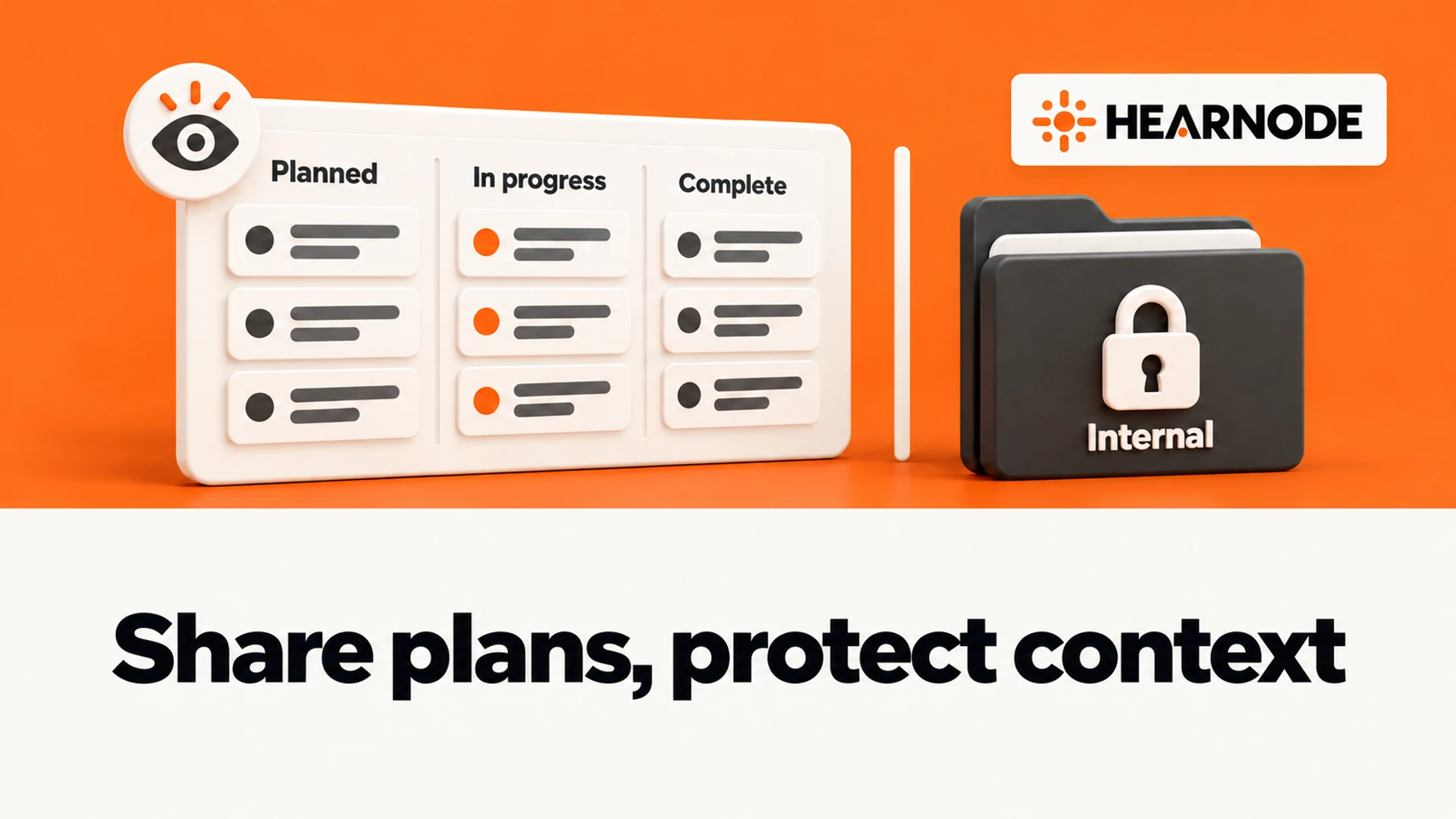
- A public board shows status columns such as Planned, In progress and Complete. You can hide any column you prefer not to show.
- A timeline lets you place items by exact date, date range or quarter. Items without a target date stay visible as undated.
- Your team sees internal target dates and private items. Customers only see what you've marked public, and public dates are always labelled as estimates.
- A change to a public target is reviewed before it goes out, and followers who opted in are told about it.
- When an item ships, link it to the release in Changelog & Announcements so the roadmap and changelog tell the same story.
The roadmap guide explains how to set up public and internal views. Most teams start with status columns and add timeline estimates for near-term work once they're comfortable.
A roadmap without dates asks customers to trust your direction rather than your calendar. That trust is earned the same way any trust is: by being clear about what you know, honest about what you don't, and reliable about telling people when things change.
Roadmap without dates: FAQs
Is a roadmap without dates better than one with dates?
For a public roadmap, usually yes. Internal roadmaps still need target dates for planning. Public roadmaps work better without exact dates, using statuses, Now, Next and Later columns, quarters or ranges instead, with firm dates only for work that is nearly done or tied to an external deadline.
What is a Now, Next, Later roadmap?
It is a roadmap format with three columns: work in progress now, work coming next and longer-term direction. It shows order and rough distance without committing to specific dates.
How do you answer customers who ask when a feature will ship?
Tell them where it sits, such as in progress, next or longer term, give a rough timeframe if you have one and promise an update when something changes. Then make sure that update actually happens.
Is a quarter too specific for a public roadmap?
For the next quarter or two, a quarter is usually fine if it is labelled as an estimate. For work further out, a quarter can be almost as fragile as an exact date, so Later or a broad range is safer.
How do you communicate a roadmap delay?
Update the roadmap as soon as you know, give a one-sentence reason, notify the people following the item and avoid replacing the missed estimate with a more precise one. Keep a record of what changed.
Put this into practice with Hearnode
The features and guides behind this article.