Product Decisions
Saying No to Customers Who Ask for Features You Won't Build
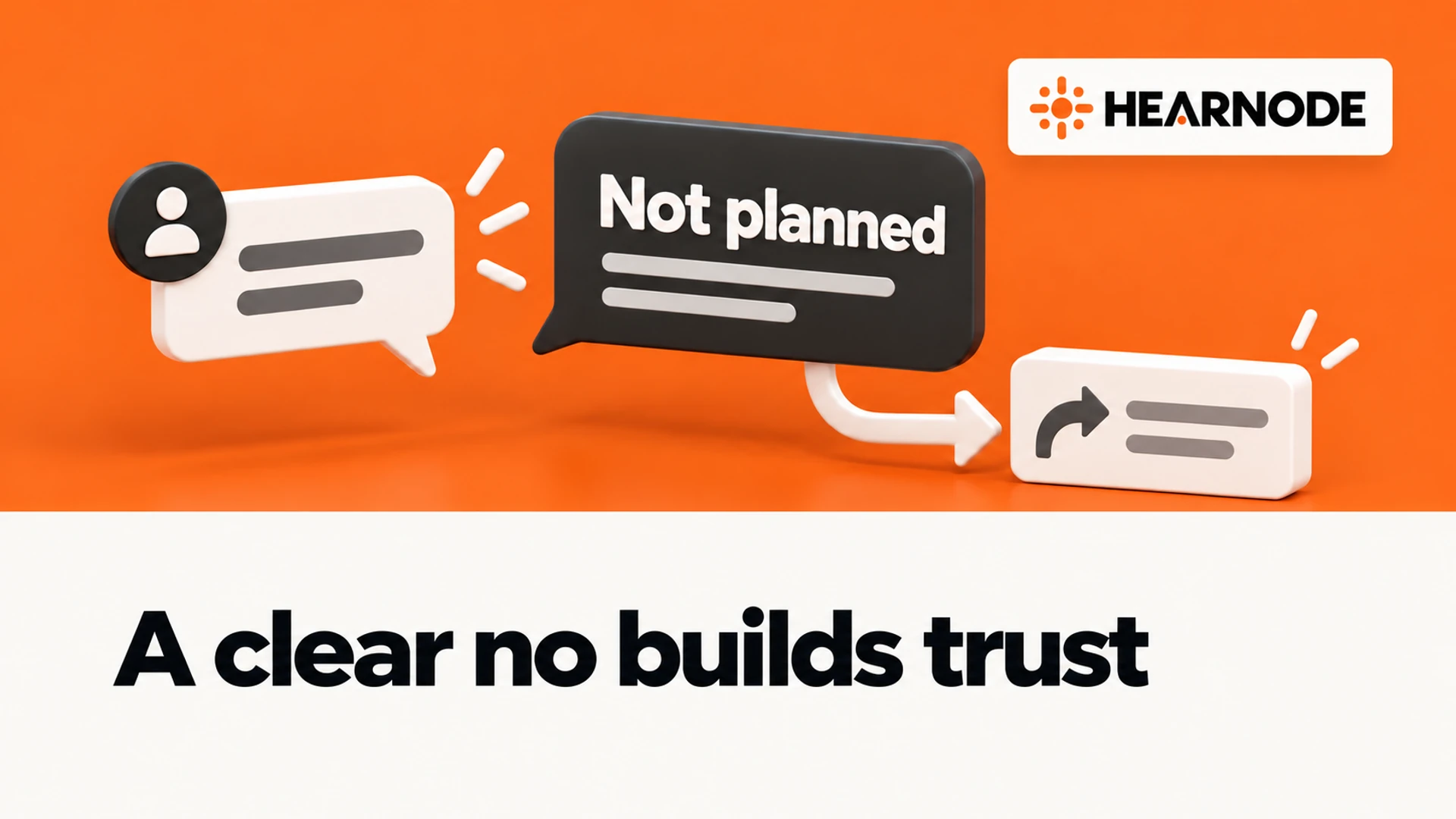
Leaving a request open feels safer than turning it down. It isn't. Customers can tell the difference between “not yet” and “never answered”, and the second one costs more trust than a clear no. This is how to get better at saying no to customers.
Hearnode Team9 min read
In This Article
- Why teams avoid saying no
- When saying no to customers is the right call
- How to say no to a customer request without losing them
- Phrases that make saying no to customers easier
- When the request comes from your biggest customer
- Saying no in public, not just in private
- Say no early, not after months of maybe
- What to do after you say no
- What not to do
- Saying no in Hearnode
- A no is still a form of listening
- Questions about saying no to customers
Every product has a corner of its feedback board where requests go to wait. Some have been open for two or three years. The original posters have long stopped checking. Every so often a new customer finds one, adds a comment saying “any update on this?”, and gets no reply. Nobody on the team decided to ignore these people. They just never decided anything at all.
It's an understandable habit. Saying no feels like it might cost a customer, while saying nothing feels free. But silence has a cost too. It's slower and harder to see. Saying no to customers clearly, with a reason, usually keeps more goodwill than a request left hanging, and it frees your team from a backlog full of maybes.
Why teams avoid saying no
It helps to name the reasons, because most of them fall apart once said out loud:
- “We might build it one day.” Maybe. But “one day” with no plan is still a no for now, and you can say that.
- “They'll leave if we say no.” A few might. Most stay, especially if the answer comes with a reason or a workaround. Many leave quietly after waiting for years.
- “It's awkward.” True. It gets much easier with practice and with a few phrases you trust.
- “Nobody owns the reply.” This is the real cause more often than any of the others. See feature request management for how to fix it.
When saying no to customers is the right call
Not every request deserves a no, obviously. But some patterns come up again and again where declining is the honest answer:
It solves a problem you have decided not to solve
If your product is deliberately simple, a request for complex workflow automation is a request for a different product. Saying yes would dilute what makes yours good for everyone else.
The cost would outlast the benefit
Some features are cheap to build and expensive to keep. Every option adds testing, support questions and screens to explain. When the ongoing cost is high and the benefit narrow, no is often right. We cover this in more depth in feature creep rarely starts with a bad idea.
It comes from the wrong customer
Sometimes a run of similar requests isn't a product gap at all. It's a sign that you're attracting buyers who expect a different kind of product. IntensePath has a sharp piece on telling feature requests apart from positioning problems, and it's worth reading before you build something just because many people asked.
You already solve the problem another way
Many requests describe a solution to a problem your product already handles, just not in the way the customer expected. The answer here is a polite no to the specific feature and a clear yes to the problem, with directions.
How to say no to a customer request without losing them
A good no has a structure. It is short, it is honest and it leaves the customer better off than silence would.
- Thank them for the specifics. Not a generic “thanks for your feedback”, but a sign you read it: “Thanks for explaining how your team handles month-end reports.”
- Say the answer plainly. “We're not planning to build this.” Avoid “not at this time” if you mean never. People can tell.
- Give the real reason in one or two sentences. You don’t need to share internal debates, but “we’re keeping the product focused on small teams, and this would mainly serve large ones” is fair and understandable.
- Offer what you can. A workaround, an existing feature that solves part of the problem, or an integration they hadn't found.
- Leave the door open honestly. If things could change, say what would change them: “If we see this from many more teams your size, we'll look again.”
Here's how that reads in practice:
“Thanks for laying out how your team approves invoices. We've talked this through and we're not going to add multi-step approval workflows. We're keeping the product simple for teams under twenty people, and approvals would add complexity most of them don't need. Many teams in your position use the comment and mention features to get a sign-off before sending. If this comes up from a lot more teams like yours, we'll look again, and you'll get an update here.”
It's six sentences. It doesn't apologise for having a product strategy, and it doesn't pretend the door is wider open than it is.
Phrases that make saying no to customers easier
Wording matters more than it should. A few swaps that tend to land better:
| Instead of | Try |
|---|---|
| “Great idea, we’ll look into it!” | “Thanks, that’s a clear explanation. Here’s where we’ve landed.” |
| “It’s on our backlog.” | “We’re not planning this in the next few months.” |
| “Not at this time.” (meaning never) | “We’ve decided not to build this.” |
| “Our engineers are too busy.” | “We’re focused on X this quarter, because Y.” |
| “We’ll let you know.” | “If that changes, you’ll get an update on this request.” |
The pattern behind all of them is the same: be specific, be honest about timing, and only promise the things you'll actually do. If you will actually update the customer when something changes, say so. If you won't, don't.
When the request comes from your biggest customer
This is the hard case, and there's no formula for it. A large account may be worth building something for. If you decide it is, treat it as a deliberate exception, written down, rather than letting it slide in as normal roadmap work. If you decide it isn't, the conversation is better handled live, by someone the customer already knows, than by a reply on a board.
Either way, avoid the middle path of saying yes and then never quite getting to it. Large customers have long memories, and a broken promise costs far more than an honest no. Our guide to how to prioritize feature requests covers how to handle exceptions without letting them take over.
Saying no in public, not just in private
If the request lives on a feedback board, the answer should live there too. A public reply and a Closed status tell everyone who voted or followed what was decided, including people who will never contact support. It also stops new customers from adding their votes to something that isn't going to happen, and then feeling misled.
Some teams go further and publish a short list of things their product deliberately doesn't do. It saves a surprising amount of back and forth, because customers can see the boundaries before they ask. A public roadmap is a natural place for that list to sit.
Say no early, not after months of maybe
Timing changes how a no lands. A clear answer a week after someone asks feels like respect. The same answer after eighteen months of silence feels like an afterthought, and it often arrives after the customer has already built a workaround or started looking elsewhere.
If you genuinely don't know yet, say that instead: “We haven't decided. We review requests like this every quarter, and you'll hear from us here when we do.” That's honest and it sets an expectation you can keep. What doesn't work is saying nothing and hoping the request fades. It doesn't fade. It just collects disappointed comments.
What to do after you say no
A declined request isn't necessarily closed forever. Keep an eye on a few things over the following months:
- Does the same request keep coming back from new customers? If it does, the demand may be bigger than you thought, or your positioning may be attracting people who expect it.
- Did anyone leave over it? If several customers cite it when they cancel, that's new information worth a second look.
- Has your strategy changed? A no that made sense for a product aimed at small teams may not hold once you start selling to larger ones.
Being willing to revisit a decision is what makes your no credible in the first place: customers can trust it because they know it's based on reasons, and that the reasons are checked.
What not to do
- Don't say “great idea!” if you won't build it. Enthusiasm reads as a promise.
- Don't hide behind “it's on our backlog”. Everything is on the backlog. It tells the customer nothing.
- Don't close requests silently. A status change with no explanation feels like being dismissed.
- Don't argue. If a customer disagrees with your reasoning, acknowledge it. You can disagree without debating.
- Don't make it personal. It's a product decision, not a judgement of their idea or their business.
Saying no in Hearnode
Hearnode's Customer Feedback boards are set up to make a clear answer the easy option. You can reply to a request publicly as your team, or leave an internal note that only your colleagues see while you discuss it.
- Moving a request to Closed records the decision where customers can see it, next to your public reply.
- Followers who asked to hear about status changes are told, so one reply reaches everyone who cared.
- If you merge a request into an existing one first, the original wording and every follower move across, so nobody is left on an orphaned request.
- Closed requests don't count against your active request capacity, so tidying up the backlog has no downside.
The feedback board guide covers public replies, internal notes and statuses in more detail.
A no is still a form of listening
It can feel strange to think of saying no as good customer service. But consider it from the customer's side. They took the time to describe a problem. A clear answer, even a disappointing one, shows that someone read it, thought about it and respected them enough to be straight. Silence shows none of those things. In the end, the products customers trust most aren't the ones that say yes to everything. They're the ones that answer.
Questions about saying no to customers
How do you politely say no to a customer request?
Thank them for the specifics, state the answer plainly, give a short honest reason, offer a workaround or alternative if one exists and say what would make you reconsider. Keep it to a few sentences.
Is it better to say no or leave a feature request open?
Saying no is usually better. A request left open for months or years reads as being ignored, and it encourages new customers to vote for something that will not happen. A clear answer with a reason keeps more trust.
Should you explain why you are saying no to customers?
Yes, briefly. One or two sentences about your focus or the trade-off involved is enough. You do not need to share internal debates, but a reason makes the decision easier to accept.
What if a customer threatens to leave over a declined feature?
Listen to what the feature would do for them, check whether an existing feature or workaround solves the underlying problem and be honest about your plans. If the request is far outside what your product is for, they may be better served elsewhere, and saying so respectfully is fair.
Should declined feature requests be deleted?
No. Close them with a public reply instead. That keeps the history, tells everyone who voted or followed what was decided and stops the same request from being posted again without an answer.
Put this into practice with Hearnode
The features and guides behind this article.