Customer Proof
Testimonial Consent Is More Than a Yes in an Email
A happy customer's email ends up on the homepage. Months later they change jobs, their employer objects, or it turns out they never agreed to their name and photo being used. Testimonial consent is about agreeing on those details before you publish, and keeping a record of what was agreed.
Hearnode Team9 min read
In This Article
- Why a yes in an email is not enough
- What testimonial consent should cover
- Editing a testimonial without changing what it means
- Company names, logos and photos
- When a customer changes their mind
- The FTC rules on testimonials, in plain terms
- Privacy and personal data
- What about testimonials you already have?
- A testimonial consent checklist
- Testimonial consent in Hearnode
- Testimonial consent FAQs
It usually starts innocently. A customer sends a lovely email. Someone replies “Do you mind if we use this?” and the customer says “Sure!” The quote goes on the homepage with their full name, job title and a photo found on a professional networking site. A year later, they've moved to a competitor, their old employer's legal team is asking questions, and nobody can say exactly what the customer agreed to.
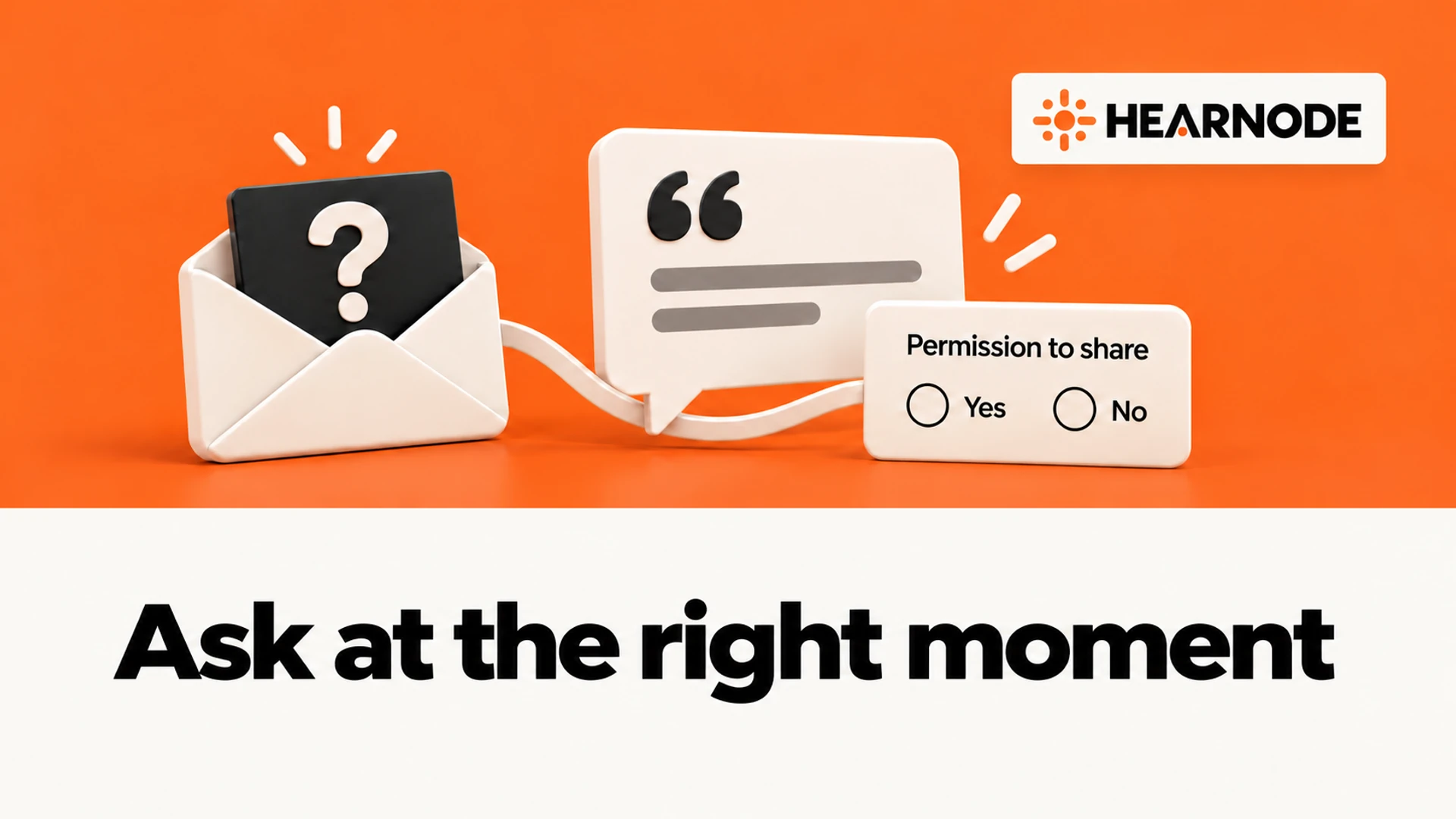
Nobody acted in bad faith. But “sure!” in an email doesn't say where the quote can appear, how the person will be named, whether a photo is included, whether the words can be shortened or what happens if they change their mind. Testimonial consent is the practice of settling those questions up front and keeping a record, so that publishing customer praise never turns into a problem for the customer or for you.
Why a yes in an email is not enough
A casual yes leaves too much open to interpretation. The customer might have imagined a short quote on a single page, while you imagined a case study, a sales deck and an advertising campaign. Neither of you was wrong. You just never discussed it.
The problems surface later, when they're hardest to fix: an employer who didn't know, a quote that has been edited into something the customer wouldn't have said, a photo they never approved, or a request to take it down that nobody knows how to handle everywhere it was used.
What testimonial consent should cover
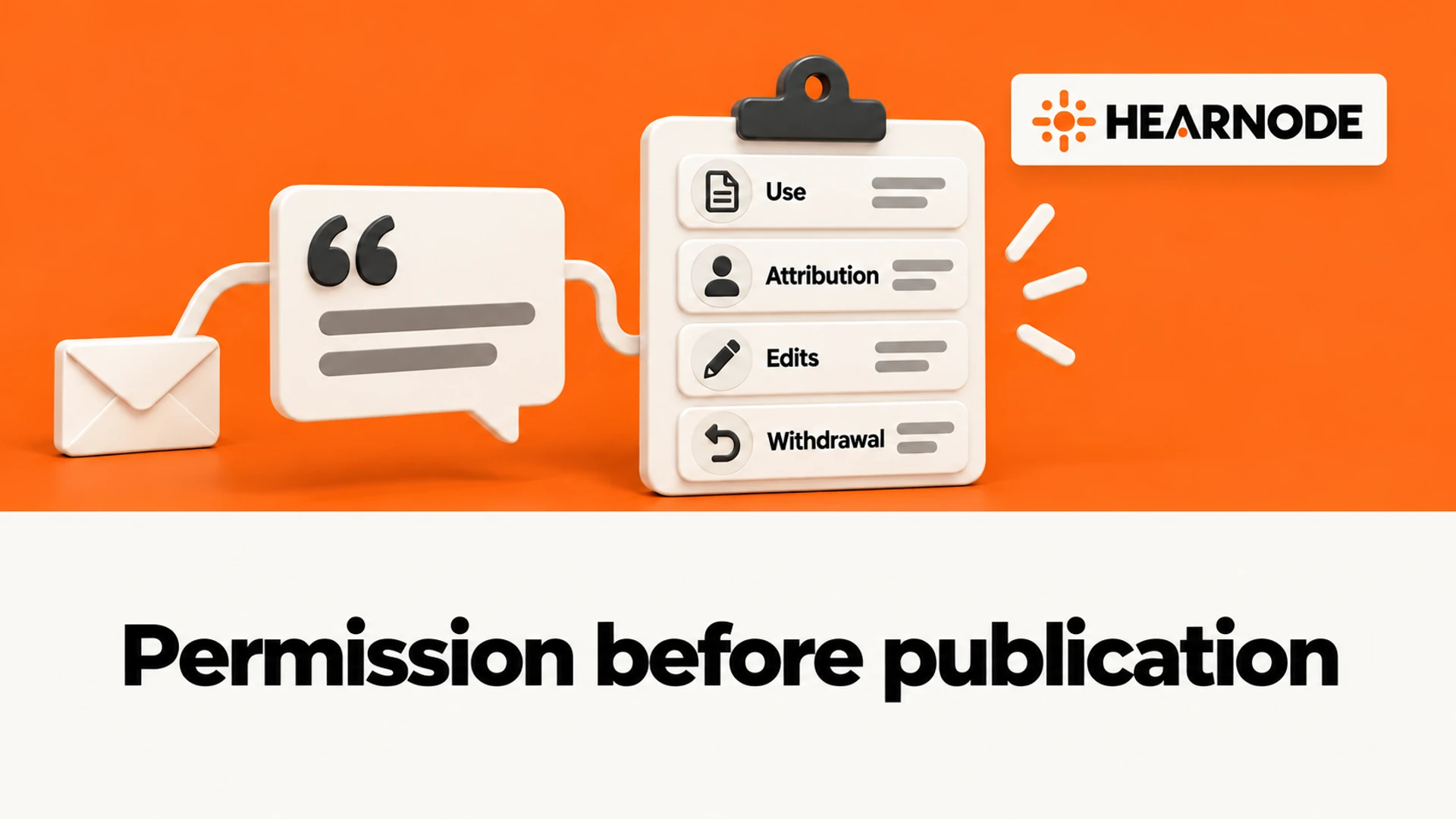
Good consent answers a handful of specific questions:
| Element | The question it answers |
|---|---|
| Where it will appear | Website, product, sales materials, social media, advertising? |
| How they are named | Full name, first name only, role, company, or anonymous? |
| Photo and logo | May you show their photo? Their company’s logo? These are separate questions. |
| Edits | May you shorten it? Will they see the version you publish? |
| Duration | Is there an end date, or until they withdraw? |
| Withdrawal | How do they ask you to stop using it, and what happens then? |
You don't need a long legal form to cover these. A few clear choices at the point where the customer submits their testimonial does the job, as long as the choices are specific and the answers are stored with the testimonial. Plain wording matters here: “May we show this quote on our website and in our product, with your first name and role?” is something a customer can answer confidently in a few seconds.
Editing a testimonial without changing what it means
Shortening a testimonial is normal. A three-paragraph email rarely works as a homepage quote. The line you shouldn't cross is changing its meaning. Some practical rules:
- Use the customer's own words. Choose an excerpt; don't rewrite.
- Keep the meaning. Don’t remove a qualifier such as “once we got past setup” if it changes what they said.
- Don't combine sentences from different parts of their message in a way that creates a new claim.
- Show them the published version if you shortened it.
- Keep the original, so anyone can check the excerpt against it later.
Company names, logos and photos
These are where well-meaning teams most often overstep. A customer agreeing to be quoted as “Head of Operations, Acme Ltd” has not necessarily agreed to Acme's logo appearing on your website. The logo belongs to the company, and many companies have rules about who can approve its use, often not the person who wrote the testimonial.
Photos work the same way. A photo you found online is not a photo the customer gave you permission to use. Ask for one, or don't use one. Treat company name, logo and photo as three separate permissions, and never assume one implies another.
When a customer changes their mind
People change jobs, companies change policies and opinions change. A customer who asks you to stop using their testimonial should find that easy, and you should be able to do it properly. That means knowing everywhere it's used: the website, widgets, sales decks, downloadable files.
For content you manage centrally, such as a testimonial gallery or widget, removal can be quick. Copies made elsewhere, such as in a slide deck someone downloaded, are harder. Keep a record of where testimonials have been used, and when one is withdrawn, work through that list. Be honest with the customer about what you can remove straight away and what will take longer.
The FTC rules on testimonials, in plain terms
If you market to people in the United States, the Federal Trade Commission has rules that apply to testimonials and reviews. This is a general overview, not legal advice; if testimonials are central to your marketing, it's worth having a lawyer review your approach.
Testimonials must be real and reflect real experience
The FTC's rule on consumer reviews and testimonials, in force since October 2024, prohibits fake testimonials, such as those attributed to people who don't exist or who didn't actually use the product, and testimonials that misrepresent the person's experience. Writing a testimonial yourself and attaching a customer's name falls squarely into this.
Material connections must be disclosed
Under the FTC's Endorsement Guides, if someone giving a testimonial has a connection that readers wouldn't expect, such as being paid, receiving a free product or discount in return, or being an employee or relative, that connection should be clearly disclosed. Incentives tied to the testimonial being positive are a particular problem.
Testimonials should still reflect the person’s views
The Endorsement Guides also expect advertisers to use an endorsement only while they have good reason to believe the person still holds the views expressed. That's another reason a simple, working withdrawal process matters.
Results claims need care
A testimonial describing an exceptional result can imply that everyone will get that result. If that's not typical, the guidance expects you to make clear what results people can generally expect. The safest testimonials describe the person's own experience in their own words, without dramatic numbers you can't stand behind.
Privacy and personal data
A testimonial usually includes personal data: a name, a role, sometimes a photo. Privacy laws in many places, such as the GDPR in Europe, set expectations about how that data is collected and used, including that consent should be specific and informed and that it can be withdrawn. Again, this isn't legal advice, but the practical habits above line up well with what these laws expect.
One more habit worth adopting: collect only the personal details you need. If you need an email address to verify who submitted a testimonial, keep it private; there's no reason for it to be published or shared. IntensePath's piece on data minimisation makes the broader case for collecting less and keeping it for less time.
What about testimonials you already have?
Most companies have a collection of older quotes: a few lines from an email, a comment from a call, a kind message in a support ticket. Some were cleared properly; many weren't. Rather than guessing, go back to the customers you can still reach and ask them to confirm, with the same specific choices you'd offer a new testimonial. Most will say yes, and some will appreciate being asked.
Where you can't reach someone, or there's no record of what they agreed to, consider retiring the quote. It's a small loss compared with the risk of publishing words someone never agreed to share. And don't confuse public reviews with testimonials you're free to reuse. A review on a third-party site was written for that site; our article on testimonials vs reviews explains the difference. Once your library is clean, where to put testimonials on your website covers how to use it well.
A testimonial consent checklist
- Ask for permission at the same time as the testimonial, not afterwards.
- Offer specific choices: where it may appear and how the person is named.
- Ask separately about photos and company logos.
- Store the exact wording of what was agreed alongside the testimonial.
- Publish excerpts only in the customer’s own words, with the meaning intact, and keep the original.
- Disclose any incentive or relationship that readers would not expect.
- Keep a record of where each testimonial is used.
- Make withdrawal simple, and act on it everywhere you can.
If you're about to ask customers for testimonials, our guide on how to ask for a testimonial shows how to fold these permission choices into the request itself, so it doesn't feel like paperwork.
Testimonial consent in Hearnode
Hearnode's Testimonials module treats permission as part of the testimonial, not an afterthought.
- The exact permission statement and use choices are stored with each testimonial, so you can always see what a customer agreed to.
- Attribution is the customer's choice. Name, role, company and photo are optional, and a company name does not grant permission to use a logo.
- Each testimonial is reviewed against the original before publishing. Display excerpts must come from the original text and keep its meaning.
- Publishing to galleries and widgets is an explicit step that happens only when every check has passed.
- Customers can withdraw. After verification, new managed displays stop and cleanup is tracked. Copies made outside Hearnode remain your responsibility to remove.
- For new direct submissions, a private verification email is collected and is never published.
The testimonials guide covers collection, review, publishing and withdrawal in detail.
Consent can sound like a legal chore, but at heart it's simply respect. A customer who said something kind about your product deserves to know exactly how their words will be used, and to be able to change their mind. Get that right, and testimonials remain what they should be: a genuine, lasting benefit for both of you.
Testimonial consent FAQs
Do you need permission to use a customer testimonial?
Yes. Ask for permission before publishing, and be specific about where the testimonial will appear and how the customer will be named. A casual “sure” in an email leaves too much open, so keep a record of what was agreed.
What should a testimonial consent form include?
Where the testimonial may be used, how the person will be attributed, separate choices for photos and company logos, whether it may be shortened, how long it may be used and how the person can withdraw. Store the answers with the testimonial.
Can a customer withdraw a testimonial?
They should be able to. Make withdrawal simple, remove the testimonial from places you control and work through any other places it was used. Under many privacy laws, consent to use personal data can be withdrawn at any time.
Can you use a customer's company logo with their testimonial?
Only with permission to use the logo specifically. Agreeing to be quoted with a company name is not the same as permission to display the company’s logo, which often requires approval from someone else at the company.
What are the FTC rules on testimonials?
In general terms, US rules prohibit fake testimonials and testimonials that misrepresent real experience, require disclosure of material connections such as payment or free products and expect results claims not to mislead. This is not legal advice; check with a lawyer for your situation.
Put this into practice with Hearnode
The features and guides behind this article.