Customer Proof
Testimonials vs Reviews: What’s the Difference, and Which Do You Need?
Businesses often treat testimonials and reviews as the same thing, then wonder why the polished quotes on their website don't persuade visitors who also check independent review sites. They're both customer praise, but they work in different ways, and you get the most from each when you treat them separately.
Hearnode Team9 min read
In This Article
- Testimonials vs reviews: the short version
- What a testimonial is
- What a review is
- Why visitors trust them differently
- Where testimonials work best
- Where reviews work best
- What a good testimonial and a good review look like
- How to use testimonials and reviews together
- Mistakes to avoid when using both
- Can you turn a review into a testimonial?
- Which does your business need first?
- Testimonials in Hearnode
- Testimonials vs reviews: FAQs
A prospect lands on your website and reads three glowing quotes from happy customers. Then, like most careful buyers, they open another tab and search for independent reviews. What they find there, whether it's a handful of mixed ratings, nothing at all, or a strong set of detailed reviews, will shape how much they believe those three quotes.
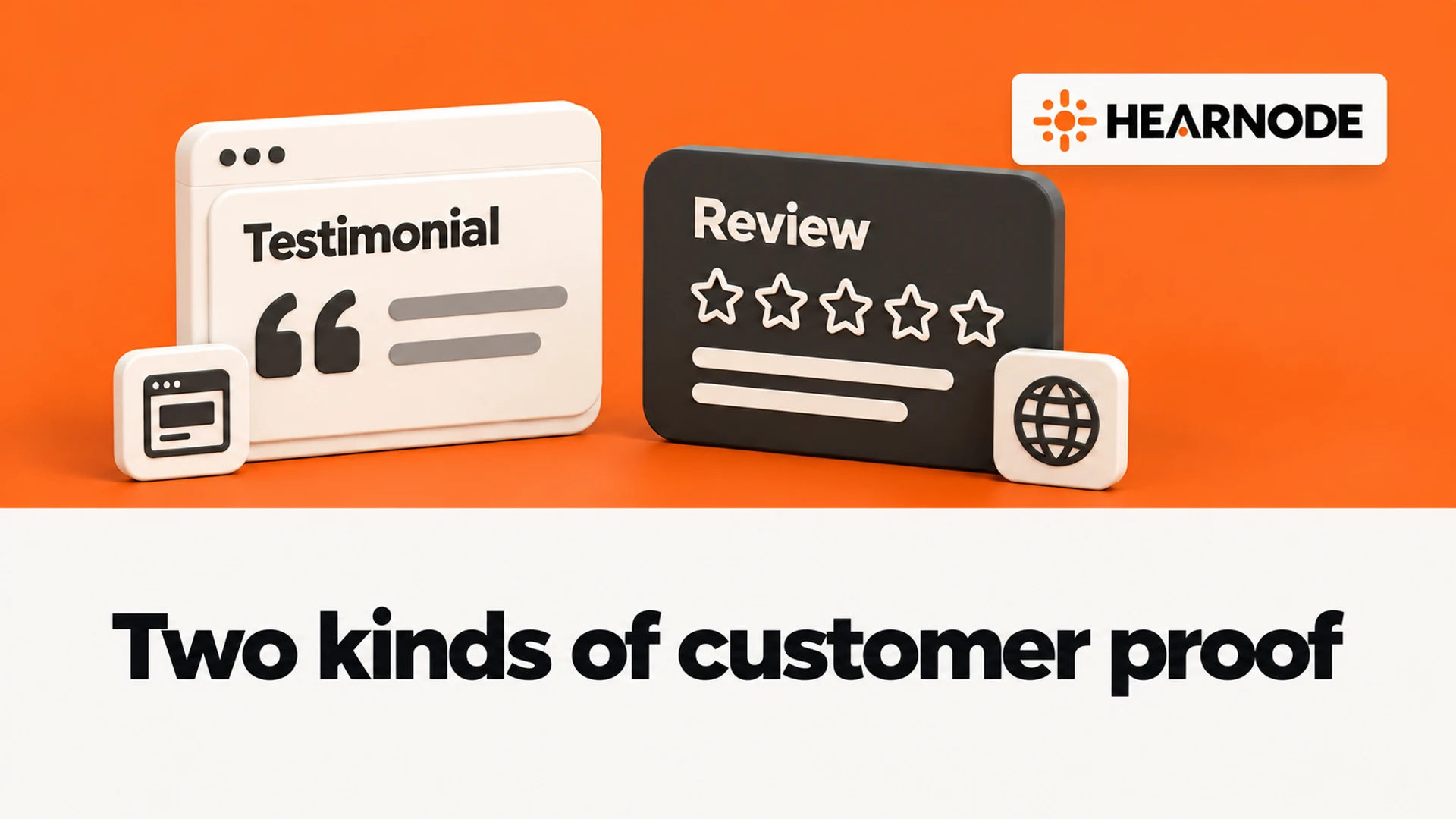
That's the essence of testimonials vs reviews. Both are customer opinions. But a testimonial is something you collect, select and present. A review is something the customer publishes, usually somewhere you don't control. Visitors know the difference, even if they've never put it into words, and they trust each kind accordingly.
Testimonials vs reviews: the short version
| Testimonials | Reviews | |
|---|---|---|
| Who collects them | You, usually by invitation | Usually an independent site or platform |
| Who chooses which are shown | You | Nobody, in principle; all are visible |
| Where they appear | Your website, product and materials | Review sites, maps listings, marketplaces |
| Typical format | A quote with a name and role | A rating plus written comments |
| Includes criticism? | Rarely | Often |
| What they persuade best | Specific value for a specific kind of customer | Overall trustworthiness |
What a testimonial is
A testimonial is a statement from a customer, collected by you, usually with their permission to publish it on your own channels. Typically it's a short quote with the person's name and role, sometimes their company and photo. You decide which testimonials to collect and which to show.
That control is a testimonial's strength and its weakness. You can choose a testimonial that speaks directly to the doubt a visitor has on a particular page, from a customer just like them. But visitors also know you chose it, so a testimonial carries some built-in scepticism. The more specific and genuine it sounds, the more of that scepticism it overcomes. A real name, a real role and a concrete detail do far more for credibility than any amount of enthusiasm, which is why it's worth asking customers for specifics rather than general praise.
What a review is
A review is an opinion a customer publishes themselves, typically on a third-party platform such as a review site, a maps listing or a marketplace. It usually includes a rating and some written comments, and it sits alongside every other review, good and bad.
Reviews are powerful precisely because you don't control them. A visitor reading forty reviews, including a few critical ones, gets a sense of what it's really like to be your customer. Interestingly, a few negative reviews often make the positive ones more believable, because a perfect record looks curated.
Why visitors trust them differently
It comes down to who did the choosing. With testimonials, visitors know the business selected the best ones. With reviews, they assume, rightly or wrongly, that they're seeing a fair cross-section. So testimonials work best as specific, relatable evidence (someone like me got this result), while reviews work best as general reassurance (lots of people use this, and most are happy).
This is also why the two can undermine each other when they don't match. Glowing testimonials alongside mediocre reviews make the testimonials look staged. Strong reviews alongside a few specific, credible testimonials reinforce each other.
Where testimonials work best
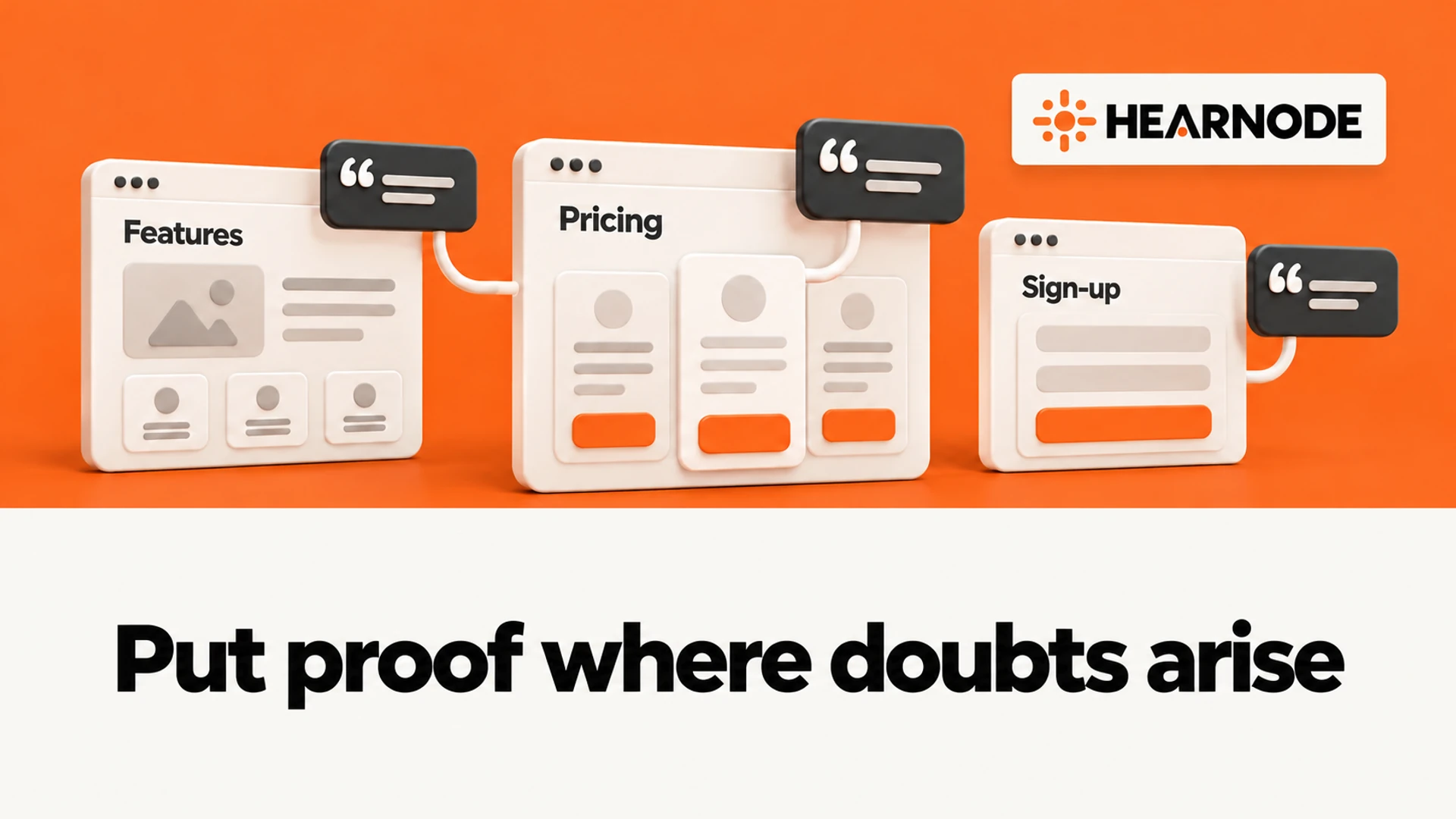
- Next to a specific claim. A quote about saving time on reporting, right next to your reporting feature.
- On pricing pages, where visitors are weighing value and want to hear from someone who has paid.
- At sign-up, to reassure people at the moment of commitment.
- In sales conversations, where a quote from someone in the same industry or role can answer a specific objection.
- Inside your product, for example in an upgrade prompt, where it speaks to the value of a feature.
The common thread is relevance. A testimonial persuades when it matches the reader and the moment. We go through placement page by page in where to put testimonials on your website.
Where reviews work best
- Where buyers search independently, such as review sites and maps listings, which is where they look before they ever reach your website.
- For local and service businesses, where ratings on maps and directories strongly influence choices.
- For products bought by individuals, who rely heavily on aggregate ratings.
- As a summary, such as your average rating and number of reviews, linked from your site to the source.
Encouraging happy customers to leave a review is perfectly reasonable, as long as you ask everyone fairly and don't offer rewards for positive ones. For businesses with a website, a simple way to do it is a visible prompt that sends satisfied visitors to the review site you care about. Flidu's Leave a Review widget is built for exactly that, sending visitors to the review destination you choose.
What a good testimonial and a good review look like
A testimonial that works
Here's an illustration we made up for this article, not a quote from a real customer, showing the qualities that make a testimonial persuasive:
“Before, our weekly report took most of Monday morning to put together. Now it's ready when we log in, and I spend that time actually reading it.” Operations manager, a twelve-person logistics team. It's specific, it describes a before and after, and it sounds like a person rather than a brochure. Placed beside a reporting feature, it answers the question a visitor is silently asking: will this help someone like me? Notice what it doesn't do: no superlatives, no exclamation marks, no claim that it changed everything. Restraint is part of what makes it believable.
A review that builds trust
A four-star review that says the product is excellent for small teams, explains that setup took longer than expected, and mentions that support helped them through it. It isn't perfect, and that's exactly why people believe it. A prospect reading it learns what to expect, including the rough edges, and is more likely to trust the five-star reviews around it.
How to use testimonials and reviews together
A simple approach that works for most businesses:
- Choose one or two review platforms that your buyers actually use, and focus your review requests there.
- Ask for reviews fairly, from customers in general, at a natural moment such as after a successful project or renewal.
- Collect testimonials separately, by invitation, with clear permission and attribution choices.
- Place testimonials where decisions happen on your website: feature pages, pricing, sign-up.
- Link to your reviews from your site, with an honest summary such as your average rating and number of reviews.
- Respond to reviews, especially critical ones. A calm, helpful reply often persuades more than the review itself.
Mistakes to avoid when using both
- Copying reviews onto your site as testimonials without the author's permission. A review was written for the platform it's on; reusing it elsewhere, especially with a name attached, needs consent.
- Showing only perfect reviews and hiding the rest. Visitors notice, and in some places selective presentation can be misleading.
- Offering incentives for positive reviews or testimonials. It biases what people say and can breach consumer protection rules.
- Writing testimonials yourself. Fake or embellished testimonials are dishonest, and in many places illegal.
- Mixing the labels. Calling hand-picked quotes “reviews” blurs a distinction visitors rely on.
Several of these touch on legal rules about endorsements and reviews. Our article on testimonial consent covers the main points in plain terms.
Can you turn a review into a testimonial?
Sometimes a review is so good you'd love to feature it. The right approach is to ask the reviewer: thank them, explain where you'd like to use it, and let them choose how they're named. Many will agree. If they don't, or you can't reach them, link to the review on the platform instead of copying it. That way it keeps its independent credibility, which is the very thing that made it valuable.
Which does your business need first?
It depends on how your customers decide:
- Local and service businesses: reviews first. Most customers will check ratings before they ever visit your website.
- Products sold to individuals online: both, with reviews doing the heavy lifting on trust.
- Software and services sold to businesses: testimonials first, since buyers want specific evidence from people in similar roles. Reviews help too, especially as you grow.
In practice, most businesses benefit from both, managed separately: reviews where buyers search, testimonials where buyers decide. Neither replaces the other, and neither needs to be perfect to be useful. If you're starting your testimonial collection, our guide on how to ask for a testimonial covers timing, wording and permission.
Testimonials in Hearnode
Hearnode handles the testimonial side: collecting customer testimonials with clear permission and publishing them on your own site and product. It doesn't collect public reviews, which belong on the platforms where buyers look for them.
- Invite customers with a personal invitation or share a general collection link.
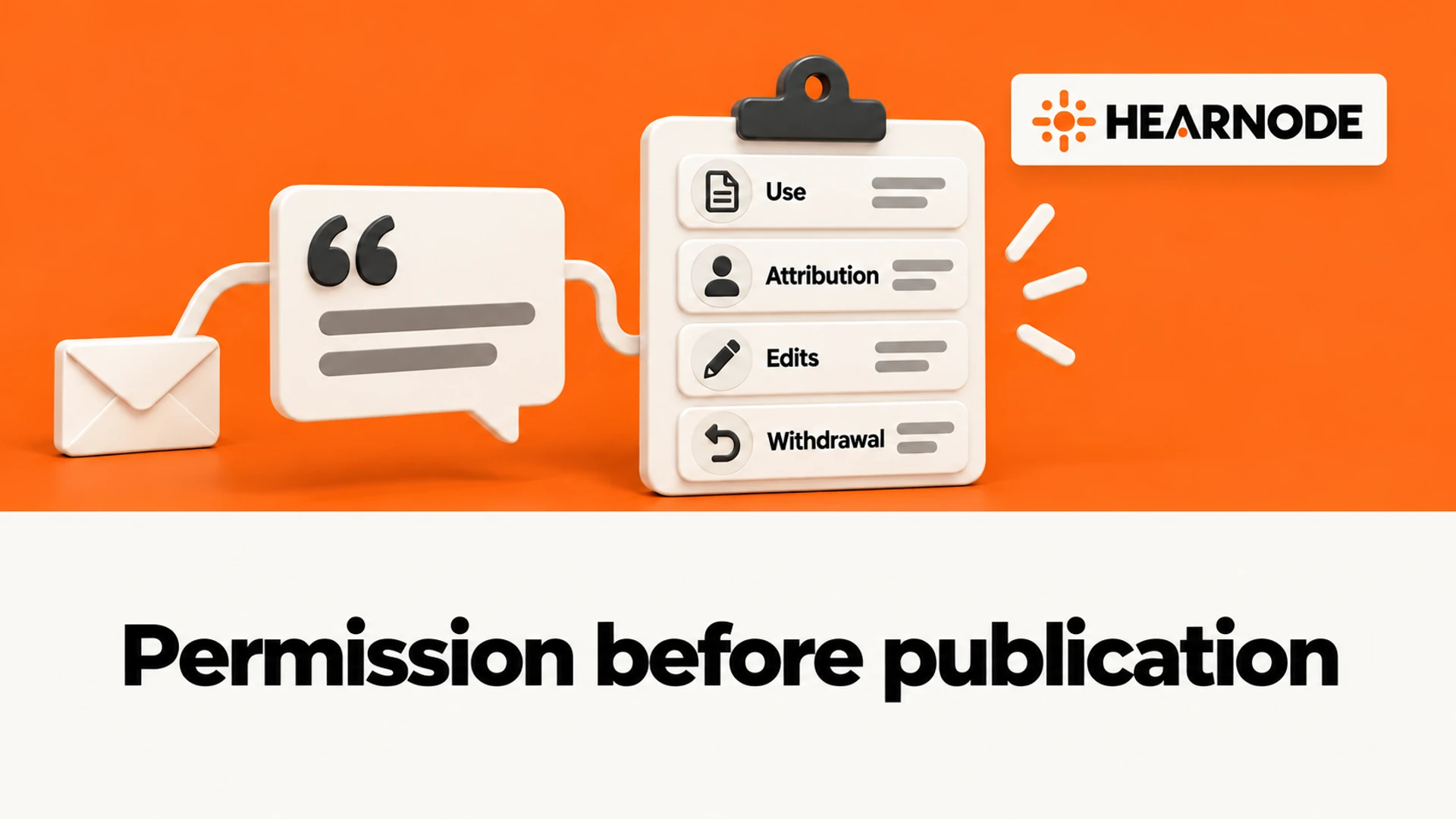
- Customers choose their own attribution. Name, role, company and photo are optional, and a company name does not grant logo permission.
- The exact permission each customer gave is stored with their testimonial.
- Testimonials are reviewed against the original before publishing, and excerpts keep the original meaning.
- Published testimonials appear in a hosted gallery or a widget as a grid, a carousel that does not auto-advance, or a single quote.
- Customers can withdraw, and new managed displays stop after verification.
See Testimonials for an overview, or the testimonials guide for setup.
Testimonials and reviews aren't competitors. Reviews tell a prospect that people generally trust you. Testimonials tell them that someone like them got something specific out of it. Treat them as two different tools, keep each honest, and they'll do more together than either could alone.
Testimonials vs reviews: FAQs
What is the difference between a testimonial and a review?
A testimonial is collected and selected by the business, usually with permission to publish on its own channels. A review is published by the customer, typically on an independent platform, alongside all other reviews. Testimonials are curated; reviews are not.
Testimonials vs reviews: which do visitors trust more?
Visitors usually see independent reviews as more trustworthy overall, because the business did not choose them. Specific, credible testimonials from relatable customers are still persuasive, especially next to a related claim on your website.
Can I put customer reviews on my website as testimonials?
Ask the reviewer for permission first, explaining where and how it will be used. If you cannot get permission, link to the review on its original platform rather than copying it.
Do I need both testimonials and reviews?
Most businesses benefit from both. Reviews build general trust where buyers search independently, while testimonials provide specific, relevant evidence where buyers make decisions, such as on pricing and feature pages.
Can I ask customers to leave a review?
Yes, as long as you ask fairly and do not offer incentives for positive reviews or only ask customers you expect to be happy. Making it easy, for example with a direct link to the review site, helps.
Put this into practice with Hearnode
The features and guides behind this article.